
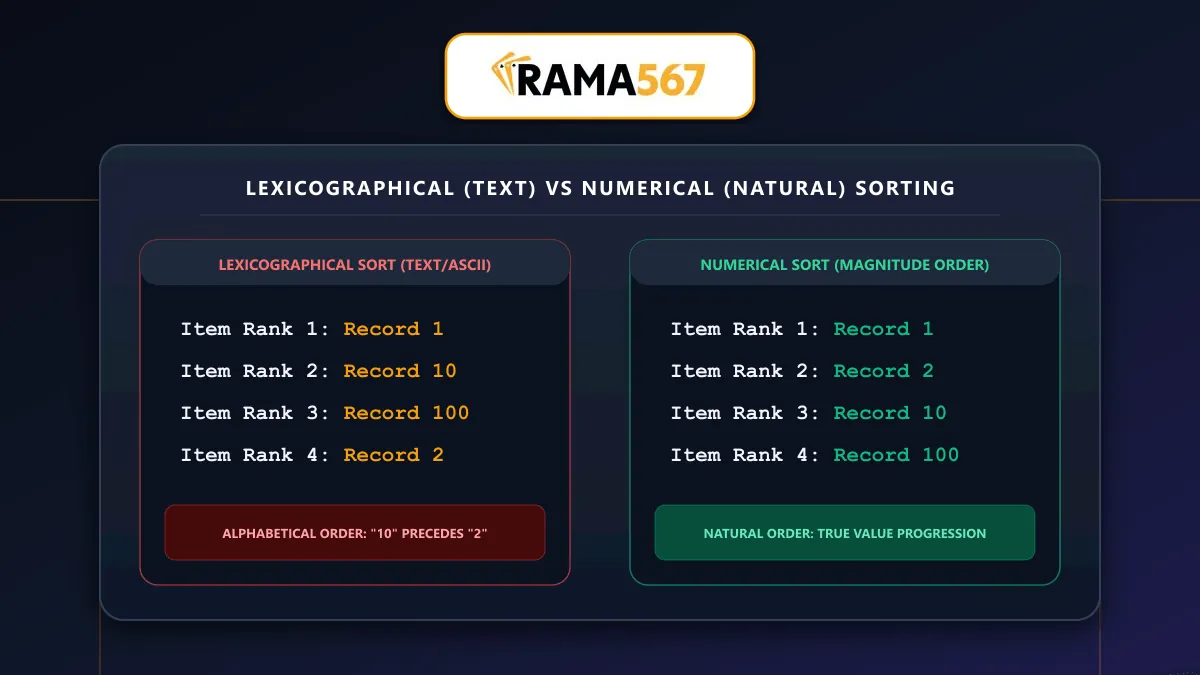
Have you ever clicked the "Sort Ascending" button on a spreadsheet or website data table, only to see the rows appear in an inexplicable, scrambled order?
Instead of progressing neatly from 1 to 2, 3, 4... the table shows: $\mathbf{1, \quad 10, \quad 100, \quad 11, \quad 12, \quad 2, \quad 20, \quad 21, \quad 3}$
To human eyes, this sequence looks completely broken. We know intuitively that 2 is smaller than 10, so why did the computer place 10 ahead of 2?
This widespread phenomenon is caused by lexicographical sorting—the method computers use when sorting numbers stored as text strings rather than numeric values. Understanding how it works is vital for anyone auditing digital archives, database results, or online financial tables.
The Root Cause: How Computers Read Characters
When a computer program (such as a web browser or a SQL database) sorts data, its behavior depends fundamentally on the column's underlying data type:
┌─────────────────────────────────────────────────────────────────┐
│ NUMERICAL DATA TYPE (INTEGER / FLOAT):                          │
│   The computer evaluates mathematical magnitude:                │
│   1 < 2 < 3 < 10 < 20 < 100                                     │
├─────────────────────────────────────────────────────────────────┤
│ TEXT STRING DATA TYPE (VARCHAR / CHAR):                         │
│   The computer evaluates character-by-character from left:      │
│   "1" < "10" < "100" < "2" < "20" < "3"                         │
└─────────────────────────────────────────────────────────────────┘
In standard computing architectures (ASCII and UTF-8), every character is assigned a specific numeric byte code:
- Character
'0'= ASCII Code 48 - Character
'1'= ASCII Code 49 - Character
'2'= ASCII Code 50 - Character
'3'= ASCII Code 51 - Character
'9'= ASCII Code 57
When comparing two text strings—say, "10" and "2"—the sorting algorithm does not calculate the total mathematical value. Instead, it inspects only the first character:
- It compares character 1 of string A (
'1') against character 1 of string B ('2'). - The ASCII code for
'1'(49) is less than the ASCII code for'2'(50). - The algorithm immediately concludes that
"10"comes before"2"and stops comparing.
It never even looks at the '0'! Just as the word “apple” appears before “banana” in a dictionary because a precedes b, the string "10" precedes "2" because '1' precedes '2'.
Lexicographical vs. Numerical: A Side-by-Side Demonstration
To visualize how severe this distortion becomes, consider ten record identifiers sorted under both methods:
| Raw Input Tokens | Text / Lexicographical Sort | True Numerical Sort | What Went Wrong in Text Sort? |
|---|---|---|---|
2 | "1" | 1 | Correct |
100 | "10" | 2 | ❌ "10" jumped ahead of 2, 3, 4, 5 |
1 | "100" | 3 | ❌ "100" jumped ahead of 2, 3, 4, 5 |
20 | "2" | 4 | Delayed behind three-digit values |
5 | "20" | 5 | ❌ "20" jumped ahead of 3, 4, 5 |
10 | "3" | 10 | Displaced |
3 | "4" | 20 | Displaced |
4 | "5" | 100 | Displaced |
In large datasets with thousands of entries, a lexicographical sort completely shatters chronological and numerical sequences. If an online ledger logs events with text keys Day 1, Day 2... Day 10, a user viewing the archive will see Day 10 immediately following Day 1, while Day 2 is buried pages later.
The Solution: Natural Sorting Algorithms
In modern software engineering, web developers solve this problem using Natural Sort algorithms.
A natural sort algorithm parses strings into chunks of text and numbers. When it encounters a sequence of digits, it evaluates them as a complete integer rather than individual characters.
In modern JavaScript (the language powering web applications like Rama567), developers use the standard ECMAScript Internationalization API:
// Standard (lexicographical) sort — broken for numeric strings:
const files = ['item1.txt', 'item10.txt', 'item2.txt'];
files.sort();
// Output: ['item1.txt', 'item10.txt', 'item2.txt']

// Natural sort using Intl.Collator:
const naturalCollator = new Intl.Collator(undefined, { numeric: true, sensitivity: 'base' });
files.sort(naturalCollator.compare);
// Output: ['item1.txt', 'item2.txt', 'item10.txt']
In SQL databases, developers prevent sorting anomalies by casting string columns to numbers during query execution:
-- Sorting text records numerically in SQL:
SELECT record_id, record_title
FROM market_archives
ORDER BY CAST(record_id AS UNSIGNED) ASC;
The Historical Workaround: Zero-Padding
Before modern natural sort libraries became standard, computer scientists and ledger clerks developed an elegant manual defense: zero-padding.
If every number in a dataset is padded with leading zeros so that all tokens share the exact same character width, lexicographical sort order becomes identical to numerical sort order:
$\text{Raw Tokens: } 1, 2, 10, 20, 100 \implies \text{Padded (Width 3): } \mathbf{001, \quad 002, \quad 010, \quad 020, \quad 100}$
Now, compare "002" and "010":
- First character:
'0'vs'0'(Equal, proceed to second character). - Second character:
'0'vs'1'('0'<'1'). - Conclusion:
"002"correctly precedes"010".
Observing Zero-Padding on Rama567
In our audit of the Rama567 historical charts, we can observe how zero-padding preserves sequence integrity in traditional market archives:
- Two-digit jodi combinations always include leading zeros for values below ten (e.g.,
01,02,03through09). - Three-digit panna combinations always preserve three characters (e.g.,
079,128).
By maintaining strict, fixed character lengths across historical datasets, tables avoid the sorting traps that plague unstandardized text files.
Checklist for Verifying Table Order Online
When analyzing an online data table or downloading open datasets, verify ordering integrity with these three checks:
- Check Row 2 and Row 3: Does
10or100appear immediately after1? If so, the table is sorted lexicographically as raw text. - Inspect Leading Zeros: Are codes padded (e.g.,
01,02) or unpadded? Unpadded text fields require natural sorting logic. - Verify the Underlying Schema: If you are building software or aggregating records, always use
Intl.Collatoron the front end or cast fields in database queries.
Explore our ongoing technical series on the Rama567 Blog to build confidence evaluating digital archives, data formats, and website presentation standards across the web.