
When browsing online financial feeds, market scoreboards, or statistical tracking boards, few phrases appear as prominently as “Live Results”, “Updated in Real Time”, or “Instant Feed”. A pulsing green indicator or an animated badge creates an impression of immediate access to ground truth.
Yet in modern software engineering, the phrase “real-time” encompasses a wide spectrum of technical architectures—ranging from sub-millisecond persistent event sockets to periodic background cron jobs that refresh once every fifteen minutes.
Understanding what real-time data actually means—and what it does not mean—is an essential data-literacy skill for anyone evaluating online numbers, historical archives, or market information.
The Four Tiers of Data Freshness on the Web
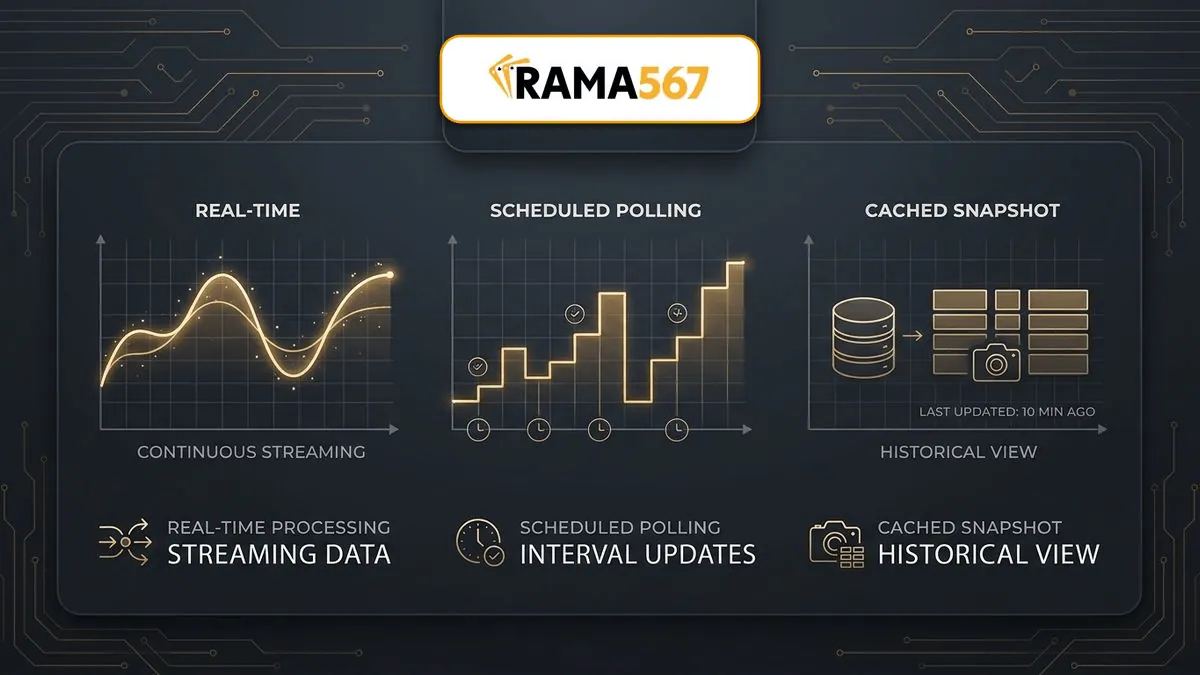
To evaluate any website making claims about speed, we must first categorize the four primary technical models used to transfer data from a database or primary feed to your screen:
| Delivery Tier | Technical Mechanism | Typical Latency | Common Use Cases |
|---|---|---|---|
| True Real-Time (Streaming) | Persistent bidirectional connections (WebSockets, SSE, WebTransport) | < 50 milliseconds to 1 second | High-frequency trading, multiplayer game state, live chat |
| Near-Real-Time (Micro-Batching) | Event-driven micro-queues, continuous push pipelines | 1 to 30 seconds | Sensor telematics, operational system dashboards, sports tickers |
| Scheduled Polling (Interval Refresh) | Client-initiated HTTP GET requests on timers (every 30s, 60s, 5m) | 30 seconds to several minutes | Financial summaries, market closing rates, weather tracking |
| Static Cache Snapshot | Pre-rendered HTML / Edge CDN caching with time-to-live (TTL) | Minutes to hours | Result archives, historical trend charts, encyclopedia tables |
1. True Real-Time (Event-Driven Push)
Under a true real-time model, the server does not wait for you to ask for new numbers. A persistent connection remains open between your browser and the origin server. As soon as a transaction or official draw is recorded upstream, a message payload is pushed down that pipeline instantly.
2. Near-Real-Time (Micro-Batching)
In many large-scale applications, processing every single individual update instantaneously would overwhelm database servers. Instead, systems bundle incoming records into small batches every 5 to 15 seconds. While human perception might call this "live," an architectural delay exists by design.
3. Scheduled Polling (Pull Architecture)
The vast majority of content websites that market "live updates" actually employ scheduled polling. Your browser runs a lightweight JavaScript script that queries a backend API endpoint every 30, 60, or 120 seconds. If a number changes at second 12, but your browser is set to poll on minute boundaries, you will experience up to 48 seconds of inherent latency.
4. Static Cached Snapshots
For high-traffic platforms that publish historical records, panel charts, and reference tables, serving live database queries to hundreds of thousands of concurrent visitors is neither practical nor resilient. These platforms compile results into static HTML or cache API payloads on Content Delivery Networks (CDNs) like Cloudflare or Fastly. The visible table is a snapshot captured at a specific timestamp.
Where Delays Actually Happen: The Latency Chain
Even when a website operates a rapid publishing pipeline, multiple infrastructure layers introduce latency before bytes reach your screen:
[ Upstream Event Occurs ]
          │
          ▼
[ Primary Source Verification & Entry ]  ─── Latency 1: Human or machine recording delay
          │
          ▼
[ Database Write & Invalidation Hook ]   ─── Latency 2: Server transaction commit
          │
          ▼
[ CDN Edge Cache & Reverse Proxy ]       ─── Latency 3: Edge TTL propagation window
          │
          ▼
[ Public Internet & Mobile Routing ]     ─── Latency 4: Network packet transit time
          │
          ▼
[ Browser Rendering & Local Cache ]      ─── Latency 5: Client-side DOM parsing & re-render
- Origin Invalidation: When a new record is added to a database, any cached HTML or JSON files sitting on global CDN edge nodes must be invalidated. If an edge node in Mumbai caches an HTML page with a 60-second TTL, visitors connecting through that node will see the previous state until that cache expires.
- Local Device Throttling: On mobile devices operating on low-power mode or background tabs, modern web browsers aggressively throttle background timer execution. A script that intended to fetch updates every 15 seconds may be delayed to every 60 or 90 seconds by the operating system.
- Session Desynchronization: If two different readers open the same webpage at 14:02:10, but User A's browser requests the page at 14:02:11 and User B at 14:02:59, User A may see a cached record that is 59 seconds older than what User B receives.
Freshness vs Accuracy: The Critical Epistemic Distinction
A common psychological bias among internet users is assuming that freshness implies accuracy. We tend to assume that because a dashboard updates rapidly, the figures displayed must be validated, rigorous, and complete.
In computational reality, freshness is solely a measurement of elapsed time, while accuracy is a measurement of factual truth.
Key Rule of Information Quality:
A number delivered in 50 milliseconds can just as easily be unverified, miscalculated, or prematurely posted as a record published after three hours of editorial audit.
When evaluating data tables—whether analyzing historical cotton exchange indices, regional market records, or sports analytics—consider these three critical distinctions:
- Speed of Transmission: How quickly a packet traveled from point A to point B.
- Integrity of Extraction: Whether the system transcribed the upstream source correctly without truncating digits or dropping units.
- Authority of the Source: Whether the origin entity had the institutional mandate or factual basis to declare that value.
A website can have world-class streaming infrastructure and still publish inaccurate figures if its upstream entry point relies on unverified transcription.
Inspecting Rama567's Real Update Architecture
As part of our commitment to transparent data presentation, let us look directly at how the Rama567 codebase and publishing pipeline function.
Rather than claiming an unverified "magic real-time" connection, examining the project repository reveals concrete architectural details:
- The website is built as an ultra-fast, statically generated application (SSG) utilizing Vite, React, and an automated build pipeline.
- Core historical reference tables, such as the historical market charts and game rules, are compiled into high-performance static pages with self-hosted typography and preloaded assets.
- Dynamic game state numbers and daily closing tables are retrieved through structured REST endpoints and cached edge distributions rather than raw, unmoderated WebSocket streaming.
This architecture is optimized for stability, high concurrency, and reader accessibility across mobile devices in India and abroad. It ensures that when you load a record, you receive a deterministic, cached snapshot rather than an unstable, fluctuating stream that could drop connection mid-session.
How to Test a Website's Freshness Claims Yourself
You do not need to take any website’s marketing claims at face value. You can inspect any site’s actual freshness mechanics using standard, built-in browser developer tools:
- Open the Network Tab: Press
F12(or right-click and choose Inspect), then navigate to the Network tab. - Filter by
WS(WebSockets): Look for persistent WebSocket connections (ws://orwss://). If the tab is empty, the website is not using continuous socket streaming. - Filter by
Fetch/XHR: Observe whether the browser issues recurringGETorPOSTrequests on a timer. Notice theTimeandIntervalbetween these requests to calculate the actual polling frequency. - Inspect HTTP Response Headers: Look at the response headers of the document:
cache-control: max-age=...: Tells you how many seconds edge servers and browsers cache the response.age: ...: Indicates how many seconds the response has been waiting inside the CDN cache.last-modified: Provides the server timestamp when the record was physically generated.
Conclusion: A Data-Literate Approach to Online Records
When an online service advertises "instant" or "real-time" data, treat that claim as an architectural descriptor rather than a seal of perfection.
Always check whether the numbers you are reading represent a live event stream, an interval poll, or a static archive snapshot. Cross-reference source disclosures, inspect update timestamps, and explore our educational guides on Rama567 Blog to build a disciplined, evidence-based approach to digital information.