
Table of Contents
- Introduction: The Algebraic Architecture of Indian Matka
- The Mathematical Engine: Modulo-10 Arithmetic & Modulo-5 Symmetry
- The Five Fundamental Conjugate Pairs (The Master Cut Table)
- Red Jodis: The 20 Sovereign Brackets of Matka Charts
- Family Jodis (Kutumb): Deconstructing the 8-Bracket Matrix
- Cut Pannas (Opposite Pattis): 3-Digit Harmonic Inversion
- Forensic Chart Analysis: Identifying Cut Patterns Across Cycles
- Debunking Common Myths: Probability vs. Gambler's Fallacy
- Tactical Portfolio Construction: Using Cut Theory for Defensive Hedging
- Summary & Verification on Rama567 Live Platforms
1. Introduction: The Algebraic Architecture of Indian Matka
In the extensive lexicon of Indian Matka, few terms are spoken with as much reverence, frequency, and misunderstanding as "Cut Ank" (कट अंक) or "Opposite Number". To the casual observer or newcomer, the concept of a cut number might sound like superstitious folklore—a pseudo-mystical shorthand developed in the bustling bazaars of 1970s Bombay to explain unexpected result swings.
However, beneath the vernacular terminology lies a surprisingly elegant, mathematically rigorous system grounded in modular arithmetic and group theory.
Far from being random arbitrary associations, Cut Anks represent an algebraic symmetry group operating on the decimal ring $\mathbb{Z}_{10}$. In Matka chart analysis—whether one is inspecting the historic Kalyan Jodi Chart, studying Time Bazar, or monitoring the late-night close of Main Bazar—Cut numbers provide the foundational grammar through which record charts are structured, categorized, and visually interpreted.
THE DUAL REFLECTION AXIS OF INDIAN MATKA THEORY
- Natural Digit: [ 0 ] [ 1 ] [ 2 ] [ 3 ] [ 4 ]
- ^ ^ ^ ^ ^
- | | | | | ← (+5 Modulo-10 Reflection)
- v v v v v
- Cut Digit: [ 5 ] [ 6 ] [ 7 ] [ 8 ] [ 9 ]
Understanding Cut Anks is not a silver bullet that grants clairvoyant predictions; rather, it is the master key to decoding how Matka markets group numbers, why certain combinations are designated as "Red Jodis", how Family Jodis (Kutumb) are calculated, and how seasoned market analysts construct disciplined hedging strategies to mitigate volatility on Rama567.
2. The Mathematical Engine: Modulo-10 Arithmetic & Modulo-5 Symmetry
To truly master Cut theory, one must step away from intuitive guesswork and examine the formal algebraic principles governing the decimal digits $0$ through $9$.
The Formal Algebraic Mapping
In mathematical notation, let the set of all single Matka Anks be defined as the cyclic group of integers modulo 10:
$\mathbb{Z}_{10} = {0, 1, 2, 3, 4, 5, 6, 7, 8, 9}$
The Cut Function $C(d)$ is a bijective mapping defined over $\mathbb{Z}_{10}$ by adding a half-cycle constant $k = 5$:
$C(d) = (d + 5) \pmod{10}$
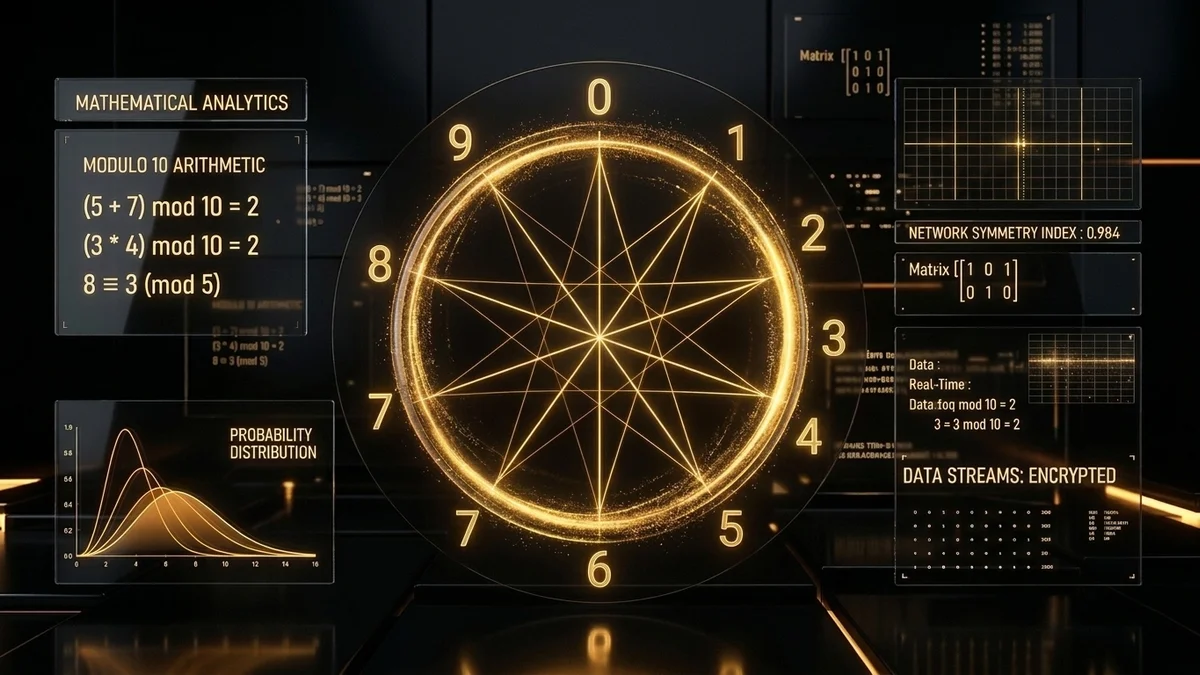
Because the decimal number system consists of 10 discrete symbols, adding 5 represents exactly one half of the entire circumference of the decimal circle ($10 / 2 = 5$). In geometric terms, if the digits 0 through 9 are arranged uniformly around the perimeter of a dial, the Cut Ank of any given number is situated at the exact diametric opposite point ($180^\circ$ phase shift).
                      (0)
                 9           1
             8                   2
           (7)                   (3)   <--- DIAMETRIC CONJUGATE PAIRS
             6                   4          (180-Degree Opposition)
                      (5)
The Involutive Principle: Self-Inverse Reflections
A fundamental property of the Cut Function is that it is an involution. An involution is a mathematical operation that acts as its own inverse. When the cut function is applied twice consecutively to any digit $d$, it returns the original starting digit:
$C(C(d)) = ((d + 5) + 5) \pmod{10} = (d + 10) \pmod{10} = d$
This property guarantees perfect bidirectional symmetry:
- If the Cut of $2$ is $7$, then the Cut of $7$ is inevitably $2$.
- If the Cut of $0$ is $5$, then the Cut of $5$ is inevitably $0$.
There are no orphan numbers, asymmetrical branches, or multi-valued mappings in Cut theory. Every single digit in the decimal universe belongs to one, and only one, conjugate pair.
3. The Five Fundamental Conjugate Pairs (The Master Cut Table)
Because the set $\mathbb{Z}_{10}$ contains exactly 10 elements, the modulo-5 involution partitions the entire number system into exactly five disjoint conjugate pairs.
Every player seeking to navigate Indian Matka charts must memorize these five pairs until their recognition becomes instantaneous.
THE MASTER MATKA CUT DIGIT REFERENCE TABLE
| Pair Index | Base Digit (Ank) | Cut Digit (Cut Ank) | Algebraic Expression |
|---|---|---|---|
| Pair I | 0 | 5 | (0 + 5) mod 10 = 5 <===> (5 + 5) mod 10 = 0 |
| Pair II | 1 | 6 | (1 + 5) mod 10 = 6 <===> (6 + 5) mod 10 = 1 |
| Pair III | 2 | 7 | (2 + 5) mod 10 = 7 <===> (7 + 5) mod 10 = 2 |
| Pair IV | 3 | 8 | (3 + 5) mod 10 = 8 <===> (8 + 5) mod 10 = 3 |
| Pair V | 4 | 9 | (4 + 5) mod 10 = 9 <===> (9 + 5) mod 10 = 4 |
Detailed Breakdown of the Five Pairs:
-
Pair 1: Zero and Five ($0 \longleftrightarrow 5$) In Indian Matka convention, the digit $0$ is frequently treated as representing the integer $10$ during card summing and panna sorting (always placed in the final position of a patti, e.g.,
120, never012). In Cut theory, however, $0$ retains its strict modular value: $0 + 5 = 5$, and $5 + 5 = 10 \equiv 0$. The $0-5$ axis is considered the central anchor of all round-sum combinations. -
Pair 2: One and Six ($1 \longleftrightarrow 6$) The $1-6$ conjugate axis represents the first odd-even non-zero reflection. On the Kalyan Day chart, shifts between $1$ and $6$ are among the most heavily studied by chartists analyzing weekly column trends.
-
Pair 3: Two and Seven ($2 \longleftrightarrow 7$) Representing the $2-7$ harmonic pair, this axis forms the foundation of classic brackets such as $22, 77, 27,$ and $72$. Whenever an analyst refers to "Family 27", they are invoking the modular symmetry of this conjugate pair.
-
Pair 4: Three and Eight ($3 \longleftrightarrow 8$) The $3-8$ conjugate axis is characterized by strong presence in historical evening markets. In Panna theory, panels summing to 13, 23, 18, or 28 naturally collapse into the $3$ or $8$ single ank.
-
Pair 5: Four and Nine ($4 \longleftrightarrow 9$) The final pair before the cycle repeats. Brackets containing $4$ and $9$ (such as $44, 99, 49, 94$) represent the highest digit pair in the decimal ring and feature heavily in weekend close analyses.
4. Red Jodis: The 20 Sovereign Brackets of Matka Charts
If you open the Rama567 Kalyan Jodi Chart or any physical Matka record book spanning the past fifty years, you will immediately notice that certain two-digit cells are rendered in bold red typography, while the majority of cells are rendered in standard black or navy ink.
These highlighted cells are universally known as "Red Jodis" (लाल जोड़ी) or "Red Brackets".
THE 20 RED JODIS IN INDIAN MATKA
- [ GROUP A: 10 PURE DOUBLES (Same Digits) ]
- 00 11 22 33 44 55 66 77 88 99
- [ GROUP B: 10 HALF RED CUT PAIRS (Opposite Digits) ]
- 05 50 16 61 27 72 38 83 49 94
Pure Doubles vs. Half Red Cut Pairs
A Red Jodi is defined by a precise mathematical condition: a two-digit bracket $XY$ is classified as a Red Jodi if and only if:
- Case 1 (Pure Double / Full Red): The Close digit is identical to the Open digit ($Y = X$).
- Case 2 (Cut Pair / Half Red): The Close digit is the exact Cut Ank of the Open digit ($Y = C(X) = (X + 5) \bmod 10$).
Let us examine the two sub-groups:
-
The 10 Pure Doubles: These occur when the Open draw and Close draw land on the exact same single digit: ${00, 11, 22, 33, 44, 55, 66, 77, 88, 99}$
-
The 10 Half Red Cut Pairs: These occur when the Open and Close draws land on conjugate opposite digits: ${05, 50, 16, 61, 27, 72, 38, 83, 49, 94}$
Combinatorial Distribution: The 20% Rule
The entire universe of Matka Jodis consists of the Cartesian product of the Open Ank set (${0\dots9}$) and the Close Ank set (${0\dots9}$):
$\text{Total Possible Jodis} = 10 \times 10 = 100 \text{ combinations } (00 \text{ through } 99)$
Because there are exactly 10 Pure Doubles and exactly 10 Cut Pairs, the total number of Red Jodis is:
$\text{Total Red Jodis} = 10 + 10 = 20 \text{ outcomes}$
Mathematically, the exact probability of a randomly drawn Jodi being a Red Bracket is:
$P(\text{Red Jodi}) = \frac{20}{100} = 0.20 = 20.0%$
This means that over a sufficiently large sample size of draws, exactly one out of every five recorded Jodis will be a Red Jodi. When reading historical charts on Rama567, observing clusters or droughts of red cells is one of the primary methods analysts use to evaluate variance and short-term market deviation.
5. Family Jodis (Kutumb): Deconstructing the 8-Bracket Matrix
One of the most powerful analytical concepts built upon Cut Anks is the "Family Jodi" (also known as a Jodi Family or Kutumb / कुटुंब).
In traditional Matka chart study, numbers are rarely viewed in total isolation. Instead, every two-digit bracket is recognized as the head of an extended family of mathematically related combinations generated through Cut substitution and positional inversion.
THE 8-BRACKET FAMILY TRANSFORMATION ENGINE
- [ Base Jodi: XY ]
- +---------------------+---------------------+
- v v
- [ Direct Pair: XY ] [ Inverted Pair: YX ]
- +--------+--------+ +--------+--------+
- v v v v
- [ Open Cut ] [ Close Cut ] [ Open Cut ] [ Close Cut ]
- C(X) Y X C(Y) C(Y) X Y C(X)
- +--------+--------+ +--------+--------+
- +---------------------+---------------------+
- [ Full Cut: C(X) C(Y) ]
- [ Full Cut Inverted: C(Y) C(X) ]
The 4-Way Transformation Algorithm
To derive the complete Family for any standard, non-red two-digit Jodi $XY$ (where $Y \neq X$ and $Y \neq C(X)$), we apply four systematic transformation operations:
- Direct Pair & Reverse (Palat):
- Base bracket: $XY$
- Positional inversion: $YX$
- Open Cut Pair & Reverse:
- Cut the Open digit: $C(X)Y$
- Reverse: $YC(X)$
- Close Cut Pair & Reverse:
- Cut the Close digit: $XC(Y)$
- Reverse: $C(Y)X$
- Full Cut Pair & Reverse:
- Cut both digits: $C(X)C(Y)$
- Reverse: $C(Y)C(X)$
Comprehensive Decomposition of Asymmetric Families
Let us take the classic example of Jodi 14 ($X=1, Y=4$):
- $C(1) = 6$
- $C(4) = 9$
Applying the transformation engine yields the 8 Family Members of 14:
| Transformation Step | Resulting Jodi | Description |
|---|---|---|
| Base Jodi | 14 | Original starting bracket |
| Reverse (Palat) | 41 | Inverted position of base |
| Open Cut | 64 | Open digit 1 replaced with Cut digit 6 |
| Open Cut Reverse | 46 | Inversion of 64 |
| Close Cut | 19 | Close digit 4 replaced with Cut digit 9 |
| Close Cut Reverse | 91 | Inversion of 19 |
| Full Cut (Both) | 69 | Both digits replaced with Cut digits (1->6, 4->9) |
| Full Cut Reverse | 96 | Inversion of 69 |
Thus, the entire Family 14 consists of:
$\text{Family}(14) = {14, 41, 19, 91, 46, 64, 69, 96}$
Notice that any of these eight numbers can be called the base number. If you calculate the family of 69, you will arrive at the exact same set of eight numbers.
Master Directory of Standard 8-Jodi Families
There are exactly 10 standard asymmetric families, each containing 8 distinct brackets ($10 \times 8 = 80$ Jodis):
- Family 12: ${12, 21, 17, 71, 26, 62, 67, 76}$
- Family 13: ${13, 31, 18, 81, 36, 63, 68, 86}$
- Family 14: ${14, 41, 19, 91, 46, 64, 69, 96}$
- Family 23: ${23, 32, 28, 82, 37, 73, 78, 87}$
- Family 24: ${24, 42, 29, 92, 47, 74, 79, 97}$
- Family 34: ${34, 43, 39, 93, 48, 84, 89, 98}$
- Family 01: ${01, 10, 06, 60, 15, 51, 56, 65}$
- Family 02: ${02, 20, 07, 70, 25, 52, 57, 75}$
- Family 03: ${03, 30, 08, 80, 35, 53, 58, 85}$
- Family 04: ${04, 40, 09, 90, 45, 54, 59, 95}$
The Degenerate 4-Bracket Double Families
What happens when we apply this family transformation to a Red Jodi (such as $11$ or $16$)?
Because the digits are already identical or cut opposites, the transformation collapses due to internal algebraic symmetry. Instead of 8 unique brackets, a Red Jodi generates a degenerate family of exactly 4 unique brackets:
Let us examine Family 11 / 16:
- Base: $11$
- Reverse: $11$ (identical)
- Open Cut: $61$
- Close Cut: $16$
- Full Cut: $66$
Thus, Family 11 contains only:
$\text{Family}(11) = {11, 66, 16, 61}$
There are exactly 5 Red Families, each containing 4 brackets ($5 \times 4 = 20$ Jodis):
- Family 00: ${00, 55, 05, 50}$
- Family 11: ${11, 66, 16, 61}$
- Family 22: ${22, 77, 27, 72}$
- Family 33: ${33, 88, 38, 83}$
- Family 44: ${44, 99, 49, 94}$
Notice how the mathematics reconciles perfectly:
$\text{Total Jodis} = (10 \text{ Asymmetric Families} \times 8) + (5 \text{ Red Families} \times 4) = 80 + 20 = 100 \text{ Jodis}$
Every single Jodi from 00 to 99 is accounted for without overlap or omission.
6. Cut Pannas (Opposite Pattis): 3-Digit Harmonic Inversion
Just as two-digit Jodis possess cut reflections, the 3-digit Panna (Patti) structures also operate under the laws of Cut theory.
Recall from our detailed analysis of Matka Mathematical Odds and Probability that a valid Matka Panna consists of three digits arranged in strict ascending order:
$d_1 \le d_2 \le d_3$
(with the standard rule that $0$ represents $10$ and is placed at the end).
CUT PANNA DERIVATION WORKFLOW
| Phase / Component | Specifications & Platform Operation |
|---|---|
| [ Original Panna | • 1-3-7 ] (Digital Sum: 1 + 3 + 7 = 11 -> Single Ank: 1) |
| [ Step 1: Modulo-5 Cut Replacement ] | • 1 -> C(1) = 6<br/>• 3 -> C(3) = 8<br/>• 7 -> C(7) = 2<br/>• Raw Unsorted Digits: [ 6, 8, 2 ] |
| [ Step 2: Ascending Order Normalization ] | • Sorting [ 6, 8, 2 ] in ascending order -> [ 2, 6, 8 ]<br/>• [ Result: Cut Panna = 268 ]<br/>• Digital Sum: 2 + 6 + 8 = 16 -> Single Ank: 6<br/>• Notice: Ank 6 is the exact Cut Ank of original Ank 1! |
Algorithm for Deriving a Cut Panna
To calculate the Cut Panna of any given 3-digit panel:
- Apply Cut Transformation to Each Digit: Replace each digit $d_i$ with its cut counterpart $C(d_i) = (d_i + 5) \bmod 10$.
- Re-Sort into Ascending Order: Because adding 5 can alter the relative order of digits, the resulting three digits must be rearranged so that $d'_1 \le d'_2 \le d'_3$.
Mathematical Proof of Digital Sum Preservation
One of the most remarkable theorems in Matka algebra is that the Single Ank of a Cut Panna is always the Cut Ank of the original Panna's Single Ank.
Proof: Let the original Panna be $P = (d_1, d_2, d_3)$ with digital sum:
$S = (d_1 + d_2 + d_3) \pmod{10}$
When we apply the cut function to each digit, the new sum $S'$ before sorting is:
$S' = (C(d_1) + C(d_2) + C(d_3)) \pmod{10}$
Substituting $C(d_i) = (d_i + 5) \bmod 10$:
$S' = ((d_1 + 5) + (d_2 + 5) + (d_3 + 5)) \pmod{10}$ $S' = (d_1 + d_2 + d_3 + 15) \pmod{10}$
Since $15 \equiv 5 \pmod{10}$:
$S' = ((d_1 + d_2 + d_3) + 5) \pmod{10} = (S + 5) \pmod{10}$
Therefore:
$S' = C(S)$
$\text{Q.E.D.}$
This mathematical certainty proves that if a panel produces an Open Ank of $4$, its Cut Panna is guaranteed to produce an Open Ank of $9$.
Panna Family Symmetry Examples:
-
Single Panna (SP) Example:
- Base Panna:
148(Sum: $1+4+8 = 13 \to$ Ank3) - Digits Cut: $1 \to 6, 4 \to 9, 8 \to 3$
- Unsorted:
6, 9, 3 - Normalized Ascending Panna:
369(Sum: $3+6+9 = 18 \to$ Ank8) - Notice that Ank
8is the exact Cut of Ank3.
- Base Panna:
-
Double Panna (DP) Example:
- Base Panna:
225(Sum: $2+2+5 = 9 \to$ Ank9) - Digits Cut: $2 \to 7, 2 \to 7, 5 \to 0$
- Unsorted:
7, 7, 0 - Normalized (remembering 0 goes to the end):
770(Sum: $7+7+0 = 14 \to$ Ank4) - Notice that Ank
4is the exact Cut of Ank9.
- Base Panna:
-
Triple Panna (TP) Example:
- Base Panna:
333(Sum: $3+3+3 = 9 \to$ Ank9) - Digits Cut: $3 \to 8, 3 \to 8, 3 \to 8$
- Normalized:
888(Sum: $8+8+8 = 24 \to$ Ank4) - Notice that Ank
4is the exact Cut of Ank9.
- Base Panna:
7. Forensic Chart Analysis: Identifying Cut Patterns Across Cycles
When experienced players examine charts on Rama567, they look for structural echoes across three primary dimensions: Cross-Session Echoes, Weekly Column Shifts, and Cross-Market Contagion.
CHART SYMMETRY PATTERN DIMENSIONS
- 1. CROSS-SESSION ECHO: Open Ank [ 2 ] ===→ Close Ank [ 7 ]
- (Forms Red Jodi 27 within the same market session)
- 2. WEEKLY COLUMN SHIFT: Monday Jodi [ 14 ]
- v (Cut Shift along weekly vertical line)
- Following Monday Jodi [ 64 ] or [ 19 ]
- 3. CROSS-MARKET CONTAGION: Sridevi Day Open [ 3 ]
- v (Harmonic mirror in subsequent bazar)
- Time Bazar Open [ 8 ]
1. Cross-Session Echoes (Open-to-Close Reflection)
A Cross-Session Echo occurs when the Close draw reflects the Open draw of the same session across the cut axis.
- For instance, if Kalyan Open declares at 04:10 PM with single ank $3$, chartists immediately recognize that a Close declaration of $8$ at 06:10 PM will seal the session as a Red Jodi ($38$).
- Tracking historical frequencies of Cross-Session Echoes reveals whether a specific market is undergoing a period of high cut compression.
2. Weekly Column Shifts & Diagonal Mirroring
In traditional panel chart layout (where columns represent days of the week—Monday through Saturday/Sunday—and rows represent successive weeks), analysts track "Line Continuity":
- When a particular family appears on a Monday (e.g., Jodi $24$), observers monitor the following Monday's cell for family rotation ($74, 29, 79$).
- Diagonal shifts occur when a cut relationship cascades diagonally across consecutive trading days (e.g., Tuesday Jodi $35 \to$ Wednesday Jodi $80$).
3. Cross-Market Contagion: Kalyan, Milan, and Rajdhani
Because many major markets share overlapping liquidity and player bases, analysts frequently inspect consecutive market schedules for harmonic echoes:
- Sridevi Day (11:35 AM – 12:35 PM)
- Time Bazar (01:00 PM – 02:00 PM)
- Kalyan Day (04:10 PM – 06:10 PM)
Observing how cut anks propagate across the daily timeline provides valuable contextual data for constructing balanced, multi-market bet slips.
8. Debunking Common Myths: Probability vs. Gambler's Fallacy
Because Cut Anks possess genuine algebraic beauty, they are frequently romanticized by dishonest tipsters and gullible players into dangerous, superstitious fallacies.
As a serious, analytical gaming platform, Rama567 believes in empowering players with absolute scientific truth.
TRUTH vs. MYTH IN CUT ANK THEORY
- MYTH: "If Open is 4, Close MUST be 9 because it is the cut!"
- TRUTH: Open and Close draws are independent cryptographic events.
- The probability of Close being 9 is EXACTLY 10.0% (1 in 10).
- The probability of Close being any other digit (0,1,2,3,4,5,6,7,8) is 10%.
- MYTH: "Red Jodis haven't hit in 10 days, so a Red Jodi is 'DUE' tomorrow!"
- TRUTH: The Gambler's Fallacy. Random generation has no memory.
- Tomorrow's probability of a Red Jodi remains EXACTLY 20.0%.
Myth 1: The "Guaranteed Cut" Trap
Unscrupulous Telegram and WhatsApp channels frequently charge exorbitant fees for所谓 "100% Guaranteed Cut Tricks" claiming: "If Open is $x$, Close will 100% be $C(x)$."
The Mathematical Reality: Every official market draw on Rama567 is determined by an audited, tamper-proof Random Number Generation (RNG) engine. The probability distribution of the Close Ank $Y$ given an Open Ank $X$ is strictly uniform:
$P(Y = C(X) \mid X) = P(Y = k) = \frac{1}{10} = 10.0% \quad \forall k \in {0, 1, \dots, 9}$
The fact that $Y$ happens to be the cut of $X$ is simply one outcome among ten equally probable possibilities. Anyone claiming certainty is attempting an advance-fee fraud.
Myth 2: "Due" Numbers and the Gambler's Fallacy
If a market has not produced a Red Jodi in 15 consecutive days, novice players often assume that the probability of a Red Jodi occurring on day 16 must be extraordinarily high.
The Mathematical Reality: This is a classic textbook illustration of the Gambler's Fallacy. Random draws possess no memory. The balls inside the drum or the pseudorandom states inside an RNG do not remember past outcomes:
$P(\text{Red Jodi on Day 16} \mid \text{15 Days of No Red}) = P(\text{Red Jodi}) = 20.0%$
Over infinite time, the Law of Large Numbers dictates that the empirical frequency will converge to 20%:
$\lim_{n \to \infty} \frac{\sum \text{Red Jodis}}{n} = 0.20$
However, in the short term, runs of 20 or 25 consecutive non-red days fall well within standard statistical variance ($0.80^{20} \approx 1.15%$, or about 1 in every 87 twenty-day streaks).
9. Tactical Portfolio Construction: Using Cut Theory for Defensive Hedging
While Cut theory cannot predict future numbers, disciplined players utilize its mathematical structure for portfolio diversification and defensive hedging.
Instead of risking their entire session bankroll on a single high-variance point prediction, experienced analysts use Cut Anks to construct balanced coverage baskets.
TACTICAL CUT ANK HEDGING ALLOCATION MODEL
- Total Allocated Session Stake: Rs 1,000
- [ Primary Anchor Bet ]
- Predicted Single Ank: [ 2 ]
- Allocation: 60% of budget (Rs 600)
- Potential Return @ 1:9.5 = Rs 5,700 (Net Profit: +Rs 4,700)
- [ Defensive Cut Hedge ]
- Conjugate Cut Ank: [ 7 ]
- Allocation: 40% of budget (Rs 400)
- Potential Return @ 1:9.5 = Rs 3,800 (Net Profit: +Rs 2,800)
- [ Net Portfolio Outcome ]
- If Ank 2 lands: Net Profit = +Rs 4,700
- If Ank 7 lands: Net Profit = +Rs 2,800
- Total Probability Coverage: 20% (Double the safety of an unhedged single)
The Open-Ank Cut Hedge Strategy
In single-digit wagering, if an analyst's chart study indicates strong bullish signals for digit $2$, the greatest operational risk is the "harmonic slip"—where the market expresses the intended line through its opposite conjugate ($7$).
By executing an Open-Ank Cut Hedge:
- The player stakes 60% of their single budget on primary Ank $2$.
- The player stakes 40% of their single budget on cut Ank $7$.
- If either digit lands, the wager not only preserves capital but delivers substantial net profit, expanding total probability coverage from 10% to 20%.
Family Jodi Coverage Modeling
Similarly, in Jodi betting, rather than staking ₹500 on a single bracket like 14 (which carries an unyielding 1% probability), a disciplined analyst might allocate ₹100 across the entire Family 14 (8 brackets: 14, 41, 19, 91, 46, 64, 69, 96 = ₹800 total stake).
Under Rama567's verified 1:95 Jodi payout multiplier:
- If any bracket in Family 14 strikes, ₹100 pays ₹9,500.
- Deducting the ₹800 total family stake leaves a net profit of ₹8,700.
- The player covers 8% of the entire 100-Jodi universe with a single coherent mathematical thesis.
Bankroll Allocation & Expected Value ($EV$) Thresholds
As detailed in our Setting Personal Limits and Discipline Guide, hedging models must always operate within strict bankroll limits:
- Never commit more than 1% to 2% of your total monthly bankroll to any single family hedge.
- Set a hard daily stop-loss limit: if your family hedge misses, cease betting for that session rather than doubling stakes (the Martingale trap).
- Immediately sweep winning payouts to your bank account using Rama567’s 5-minute instant UPI cashout system.
10. Summary & Verification on Rama567 Live Platforms
Cut Anks and opposite digits represent the intellectual core of Indian Matka. When stripped of superstition and sensationalism, Cut theory reveals itself as an elegant system of modular arithmetic that empowers players to:
- Understand the structural mechanics of the 20 Red Jodis on historical charts.
- Effortlessly decompose any two-digit bracket into its complete 8-Jodi Family.
- Derive Cut Pannas while mathematically preserving digital sum properties.
- Construct disciplined, low-volatility hedging portfolios that protect capital against harmonic market swings.
At Rama567, we provide the digital tools, ultra-fast chart archives, and transparent gaming environment necessary to put this theoretical knowledge into practice. Explore our comprehensive Jodi Charts and Panel Charts, read our beginner-friendly How to Play Guide, and enjoy seamless, instant gameplay with India's highest payout multipliers on the Rama567 Android App.