
Table of Contents
- Introduction: Moving Beyond Basic Jodi Guesswork
- Jodi Charts vs. Panel Charts: Understanding the Core Difference
- The Anatomical Structure of a Matka Panel Chart
- The Mathematical Engine Underlying Every Panel
- The Symmetrical 22-Panna Distribution Matrix
- Top 5 Technical Methodologies to Analyze Panel Charts Like a Pro
- Navigating Live and Lifetime Panel Archives on Rama567
- Bankroll Discipline for Panel Wagering
- Frequently Asked Questions (FAQ)
- Conclusion and Next Steps
Introduction: Moving Beyond Basic Jodi Guesswork
In the expansive ecosystem of Indian Satta Matka, casual players often restrict their vision to the surface level of the game: the two-digit Jodi (bracket) or the isolated single digit (Ank). They scan a scoreboard, notice a result like 38, and attempt to predict future outcomes using superstitions, unverified social media tips, or sheer guesswork.
However, professional market analysts and veteran statisticians know that looking only at the two-digit Jodi is like reading only the summary of a book without examining the chapters that generated it.
Every single digit in a Matka market is the direct mathematical output of a three-digit sequence known as a Panna (or Patti). The comprehensive ledger that archives these complete three-part sequences across days, weeks, and decades is known as the Matka Panel Chart.
When you master the ability to read and interpret a panel chart, you unlock a granular view of market behavior. You can identify when single-digit distributions are clustering, whether a market is cycling through Single Panas (SP) or Double Panas (DP), how cut-digit relationships alternate between day and night sessions, and how to spot high-probability patterns across flagship markets like Kalyan, Milan Day, and Rajdhani Night.
In this masterclass guide, we deconstruct the anatomical structure of Matka panel charts, break down the mathematical laws governing the 220 valid Panna configurations, and provide five professional technical methodologies to analyze panel records with disciplined accuracy on Rama567.
Jodi Charts vs. Panel Charts: Understanding the Core Difference
Before examining specific analytical techniques, it is essential to distinguish between the two primary chart formats available on the Rama567 Charts Directory:
| Feature Comparison | Jodi Chart | Panel (Patti) Chart |
|---|---|---|
| Displayed Data | 2-Digit Bracket only (e.g. 29) | Full 3-Part String: |
| Open Pana - Jodi - Close Pana | ||
| (e.g. 345 - 29 - 180) | ||
| Analytical Depth | Macro Level (Tracks basic | Micro Level (Tracks digit |
| pair frequencies) | summation, panel types, cuts) | |
| Combinations Shown | 100 possible Jodis (00 to 99) | All 220 valid three-digit |
| Panas (120 SP, 90 DP, 10 TP) | ||
| Primary User Base | Casual & Intermediate Players | Professional Analysts & |
| High-Multiplier Strategists |
While a Jodi Chart tells you what the final outcome was, a Panel Chart reveals how that outcome was constructed. Because payout multipliers for Panna formats on Rama567 reach 1:160 on Single Panna, 1:320 on Double Panna, and up to 1:700 on Triple Panna, reading the panel chart is mandatory for any player targeting high-multiplier formats.
The Anatomical Structure of a Matka Panel Chart
At first glance, a historical panel chart looks like a dense matrix of three-digit numbers and two-digit centers. However, every legitimate chart follows a strictly standardized, standardized layout.
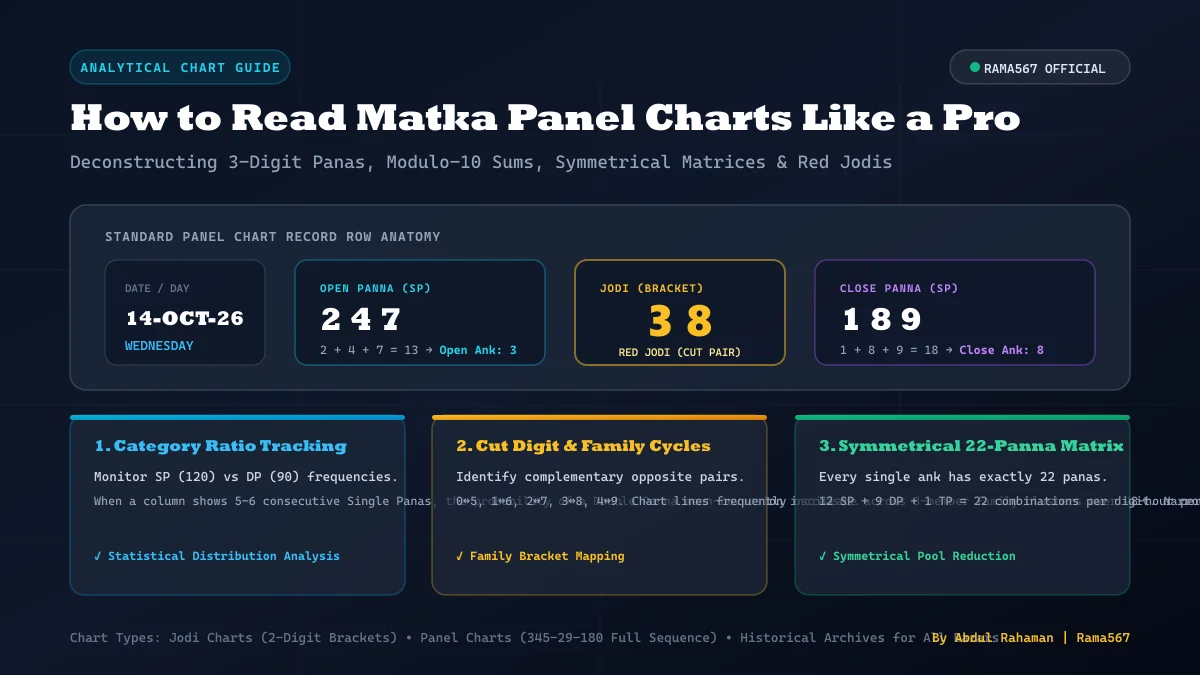
       ┌─────────────────────────────────────────────────────────────┐
       │                Standard Panel Chart Record Row              │
       ├──────────────┬──────────────────┬───────────┬───────────────┤
       │ Date & Day   │ Open Panna       │ Jodi Core │ Close Panna   │
       ├──────────────┼──────────────────┼───────────┼───────────────┤
       │ 14-OCT (WED) │ 2  4  7          │   3   8   │ 1  8  9       │
       │              │ (2+4+7=13 -> 3)  │  (Bracket)│ (1+8+9=18->8) │
       └──────────────┴──────────────────┴───────────┴───────────────┘
Reading the Full Record Notation (345 - 29 - 180)
Every daily entry in a panel chart is documented as a compound string:
$\mathbf{\text{Open Pana} - \text{Jodi} - \text{Close Pana}}$
Taking the canonical example 345 - 29 - 180:
- The Left Group (
345): The Open Panna. These are the three digits drawn during the market’s opening session. Added together: $3 + 4 + 5 = 12$. The units digit is2, establishing the Open Single Ank. - The Center Group (
29): The Jodi. Formed by concatenating the Open Single Ank (2) with the Close Single Ank (9). - The Right Group (
180): The Close Panna. These are the three digits drawn during the market’s closing session. Added together: $1 + 8 + 10 = 19$ (remembering that $0$ represents $10$). The units digit is9, establishing the Close Single Ank.
Date, Day Columns, and Historical Pagination
In standard digital archives, panel charts are organized into weekly tables:
- Rows: Represent individual calendar weeks (starting from Monday and progressing to Sunday).
- Columns: Represent the individual days of the week (Monday through Friday for weekday bazars like Rajdhani; Monday through Sunday for seven-day bazars like Milan Day and Kalyan).
- Each weekday cell contains the complete three-part notation, allowing you to easily scan down a specific day of the week across several months.
The Mathematical Engine Underlying Every Panel
To interpret panel charts accurately, an analyst must understand the three non-negotiable mathematical rules that govern every entry:
1. The Ascending Numerical Order Rule
In official Matka mathematics, the digits within any Panna must always be ordered from lowest to highest value:
$d_1 \le d_2 \le d_3$
If the three physical draw tokens drawn are 8, 2, and 5, the system sorts and records them strictly as 258. A notation like 852 or 528 is invalid and impossible on verified platforms.
2. The Modulo-10 Summation Protocol
The Single Ank is extracted by taking the algebraic sum of the three panel digits and applying a modulo-10 operation:
$\text{Ank} = (d_1 + d_2 + d_3) \pmod{10}$
- Zero as Ten: The digit 0 represents 10 in Matka summation and ascending order. Thus,
120represents $1 + 2 + 10 = 13 \rightarrow$ Ank:3. - Double Zeroes: In
100, the calculation is $1 + 10 + 10 = 21 \rightarrow$ Ank:1. - Triple Zero:
000is $10 + 10 + 10 = 30 \rightarrow$ Ank:0.
3. The 220 Valid Panna Universe (SP, DP, TP)
Because of the ascending order rule, the 1,000 raw three-digit permutations ($000$ to $999$) condense into a finite set of exactly 220 valid Panas:
- Single Panna (SP): Three completely unique digits ($d_1 < d_2 < d_3$). Total: $\binom{10}{3} = \mathbf{120}$ combinations (54.55% of all draws).
- Double Panna (DP): Two identical digits and one distinct digit ($d_1 = d_2 < d_3$ or $d_1 < d_2 = d_3$). Total: $10 \times 9 = \mathbf{90}$ combinations (40.91% of draws).
- Triple Panna (TP): All three digits identical ($d_1 = d_2 = d_3$). Total: $\mathbf{10}$ combinations ($000, 111, \dots, 999$, 4.54% of draws).
$120 \text{ (SP)} + 90 \text{ (DP)} + 10 \text{ (TP)} = 220 \text{ Total Panas}$
The Symmetrical 22-Panna Distribution Matrix
One of the most powerful analytical concepts in panel chart interpretation is the 22-Panna Distribution.
The 220 valid Panas are distributed perfectly evenly across all ten single digits ($0$ through $9$). Each single digit is formed by exactly 22 unique Panas:
- 12 Single Panas (SP)
- 9 Double Panas (DP)
- 1 Triple Panna (TP)
- Total: $12 + 9 + 1 = \mathbf{22 \text{ Panas per Ank}}$
| Ank | Single Panas (12 SP) | Double Panas (9 DP) | TP (1) |
|---|---|---|---|
| 1 | 128, 137, 146, 236, 245, 290, 380, 470, 489, 560, 579, 678 | 119, 155, 227, 335, 344, 399... | 777 |
| 2 | 129, 138, 147, 156, 237, 246, 345, 390, 480, 570, 589, 679 | 110, 228, 255, 336, 499, 660... | 444 |
| 3 | 120, 139, 148, 157, 238, 247, 256, 346, 490, 580, 670, 689 | 111*, 166, 229, 337, 355, 445... | 111 |
| 4 | 130, 149, 158, 167, 239, 248, 257, 347, 356, 590, 680, 789 | 112, 220, 266, 338, 446, 455... | 888 |
| 5 | 140, 159, 168, 230, 249, 258, 267, 348, 357, 456, 690, 780 | 113, 122, 177, 339, 366, 447... | 555 |
| 6 | 123, 150, 169, 178, 240, 259, 268, 349, 358, 367, 457, 790 | 114, 222*, 277, 330, 448, 466... | 222 |
| 7 | 124, 160, 179, 250, 269, 278, 340, 359, 368, 458, 467, 890 | 115, 133, 188, 223, 377, 449... | 999 |
| 8 | 125, 134, 170, 189, 260, 279, 350, 369, 378, 459, 468, 567 | 116, 224, 233, 288, 440, 477... | 666 |
| 9 | 126, 135, 180, 234, 270, 289, 360, 379, 450, 469, 478, 568 | 117, 144, 199, 225, 333*, 559... | 333 |
| 0 | 127, 136, 145, 190, 235, 280, 370, 389, 460, 479, 569, 578 | 118, 226, 244, 299, 334, 550... | 000 |
Strategic Advantage:
When your chart analysis points to an impending Open Ank of 7 on Milan Day, you do not need to guess blindly from 220 possibilities. You immediately focus your attention on the 22 specific Panas that can mathematically generate a 7.
Top 5 Technical Methodologies to Analyze Panel Charts Like a Pro
Equipped with the 220-Panna distribution, you can apply structured technical frameworks to historical charts rather than relying on intuition.
Method 1: Category Ratio & Mean-Reversion Tracking
Because the statistical distribution of Panas in a fair drum is 54.55% SP, 40.91% DP, and 4.54% TP, over extended samples, the frequency of outcomes will naturally regress toward these percentages.
   ┌────────────────────────────────────────────────────────┐
   │             Category Tracking Protocol                 │
   ├────────────────────────────────────────────────────────┤
   │ If Column shows: SP -> SP -> SP -> SP -> SP -> SP     │
   │                                                        │
   │ Analysis: Single Panas are heavily over-indexed.       │
   │ Mean-reversion pressure favors Double Panna (DP)       │
   │ emergence on subsequent draws.                         │
   └────────────────────────────────────────────────────────┘
- When an analyst notices that a market has declared 6 or 7 consecutive Single Panas on the Open session, the probability of a Double Panna appearing increases from a variance rebalancing standpoint.
- Conversely, back-to-back Double Panas are relatively uncommon ($40.91% \times 40.91% \approx 16.7%$), signaling high likelihood of a Single Panna on the next session.
Method 2: Columnar Weekday Pattern Mapping
Many bazars exhibit distinct patterns along vertical weekday columns. For example, when evaluating the Kalyan Panel Chart, inspect the vertical Wednesday Column over the past 8 weeks:
- Note whether the Open Ank repeatedly lands within the high range ($5, 6, 7, 8, 9$) or low range ($0, 1, 2, 3, 4$).
- Look for Repeating Panel Digits: If Wednesday Open Panas frequently incorporate the digit
3(e.g.,139,346,238), analysts prioritize Panas containing3when constructing Cycle Patti tickets.
Method 3: Cut Digits and Complementary Panel Rotations
Every single digit has a complementary cut digit separated by 5 units: $0 \leftrightarrow 5, \quad 1 \leftrightarrow 6, \quad 2 \leftrightarrow 7, \quad 3 \leftrightarrow 8, \quad 4 \leftrightarrow 9$
Professional analysts extend this concept to Cut Panas, where each individual digit of a three-digit sequence is converted to its opposite:
- The cut of Panna
124is679($1+5=6, 2+5=7, 4+5=9$). - If a market declares
124on Monday Open, check the Close session or Tuesday Open for appearances of its cut counterpart679or related family variants.
Method 4: Family Bracket Oscillations
A standard Jodi belongs to an eight-member family formed by substituting digits with their cut counterparts.
For instance, the family of 24 consists of:
${24, 29, 74, 79, 42, 92, 47, 97}$
When observing a panel chart:
- Note the Jodis formed in the center column.
- Frequently, when a market enters a "Family Cycle," the results over a 48-to-72 hour window will bounce exclusively within that 8-member bracket set.
- Tracking the corresponding Open and Close Panas allows you to narrow down your wagering pool to the 22 Panas representing those specific family anks.
Method 5: Frequency Gap and Overdue Panel Identification
Using digital record search on Rama567:
- Track which of the 10 Triple Panas ($000$ to $999$) has not appeared across any major market over the last 90 to 180 days.
- While individual Triple Panas are rare ($1:220$), an overdue TP represents an attractive long-shot hedging opportunity when backed by a disciplined ₹10 or ₹20 stake paying 1:700.
Navigating Live and Lifetime Panel Archives on Rama567
Rama567 offers one of India’s most comprehensive, up-to-date panel chart archives. Our digital tables are updated within sub-seconds of official draw declarations via live WebSocket connections:
- Kalyan Panel Chart: The definitive record for India’s most iconic afternoon market.
- Milan Day Panel Chart: Complete historical ledger for prime mid-day trading.
- Milan Night Panel Chart: Extensive evening records with full Open/Close breakdown.
- Rajdhani Day Panel Chart: Weekday afternoon records for capital market enthusiasts.
- Rajdhani Night Panel Chart: High-liquidity late-night records.
- Time Bazar Panel Chart: Morning market archives with fast result indices.
All records are fully responsive, searchable, and formatted cleanly on both desktop screens and mobile devices via the Rama567 Android APK.
Bankroll Discipline for Panel Wagering
Because individual Panna probability is 1 in 220 ($0.45%$), wagering on Panas requires strict adherence to risk management protocols:
                  ┌─────────────────────────────────────────┐
                  │      Pyramid Staking Distribution       │
                  ├─────────────────────────────────────────┤
                  │ 70% Stake: Single Ank (Base Defense)    │
                  │ 20% Stake: Jodi Bracket (Balanced Core) │
                  │ 10% Stake: Panna (High-Multiplier Boost)│
                  └─────────────────────────────────────────┘
- The 1% Maximum Exposure Rule: Never wager more than 1% of your total liquid balance on any single Panna. If your balance is ₹10,000, keep individual Panna stakes at ₹50 to ₹100.
- Pyramid Staking Allocation: Always anchor high-multiplier Panna bids to a foundational Single Ank wager (70% on Ank at 1:9.5, 20% on Jodi at 1:95, 10% on Panna at 1:160). If your Single Ank lands, your overall session produces a profit even if the exact Panna misses.
- Automated UPI Profit Sweeping: Whenever a high-paying Panna hits (e.g., ₹100 winning ₹16,000 on SP), immediately withdraw 50% to 70% of the net profit to your bank account via Rama567’s instant 24/7 UPI withdrawal service.
For a full breakdown of capital preservation techniques, review our Top 7 Bankroll Management Tips.
Frequently Asked Questions (FAQ)
What is the exact difference between a Jodi Chart and a Panel Chart?
A Jodi Chart records only the two-digit core outcome (e.g., 29), whereas a Panel Chart records the complete three-digit Open Panna, the center Jodi, and the three-digit Close Panna (345 - 29 - 180), providing full visibility into how numbers were derived.
How many total valid Panas are there in Satta Matka?
There are exactly 220 valid Panas. Because all digits must be arranged in ascending numerical order ($d_1 \le d_2 \le d_3$, with $0$ representing $10$), the 1,000 potential three-digit permutations normalize into 120 Single Panas (SP), 90 Double Panas (DP), and 10 Triple Panas (TP).
What is the 22-Panna Rule?
The 22-Panna rule refers to the symmetrical property of Matka math: each single digit from $0$ through $9$ is formed by exactly 22 unique Panas (12 Single Panas, 9 Double Panas, and 1 Triple Panna).
What is a Red Jodi on a Panel Chart?
A Red Jodi (or Red Bracket) occurs when both digits of a Jodi are identical (e.g., 11, 44, 77) or when they form a cut pair separated by 5 units (e.g., 16, 27, 38, 49, 50). They are highlighted in red on historical charts to indicate market reset states.
What are the payout rates for Panna betting on Rama567?
Rama567 offers industry-leading rates: 1:160 for Single Panna (₹10 wins ₹1,600), 1:320 for Double Panna (₹10 wins ₹3,200), and 1:700 for Triple Panna (₹10 wins ₹7,000), settled instantly to your wallet.
Conclusion and Next Steps
Learning how to read and interpret Matka Panel Charts elevates your understanding from basic speculation to data-driven analysis. By understanding the 220-Panna universe, tracking SP-to-DP category ratios, mapping cut-digit rotations, and respecting the 22-Panna distribution for each single digit, you can approach the market with professional clarity.
Put your analytical skills to work with verified live data and instant payouts:
- 📊 Inspect Master Records: Explore the Live Panel Charts Directory.
- 📲 Download the Mobile Client: Install the Rama567 Android APK for real-time alerts.
- 🎯 Start Playing: Register at Rama567 to experience fast, transparent gaming.
Disclaimer: Online matka and number gaming involve financial risk and may be habit-forming. This publication is strictly for educational, informational, and analytical purposes. Participants must be 18 years of age or older and comply with all applicable local, state, and national regulations governing real-money gaming in their respective jurisdictions.