
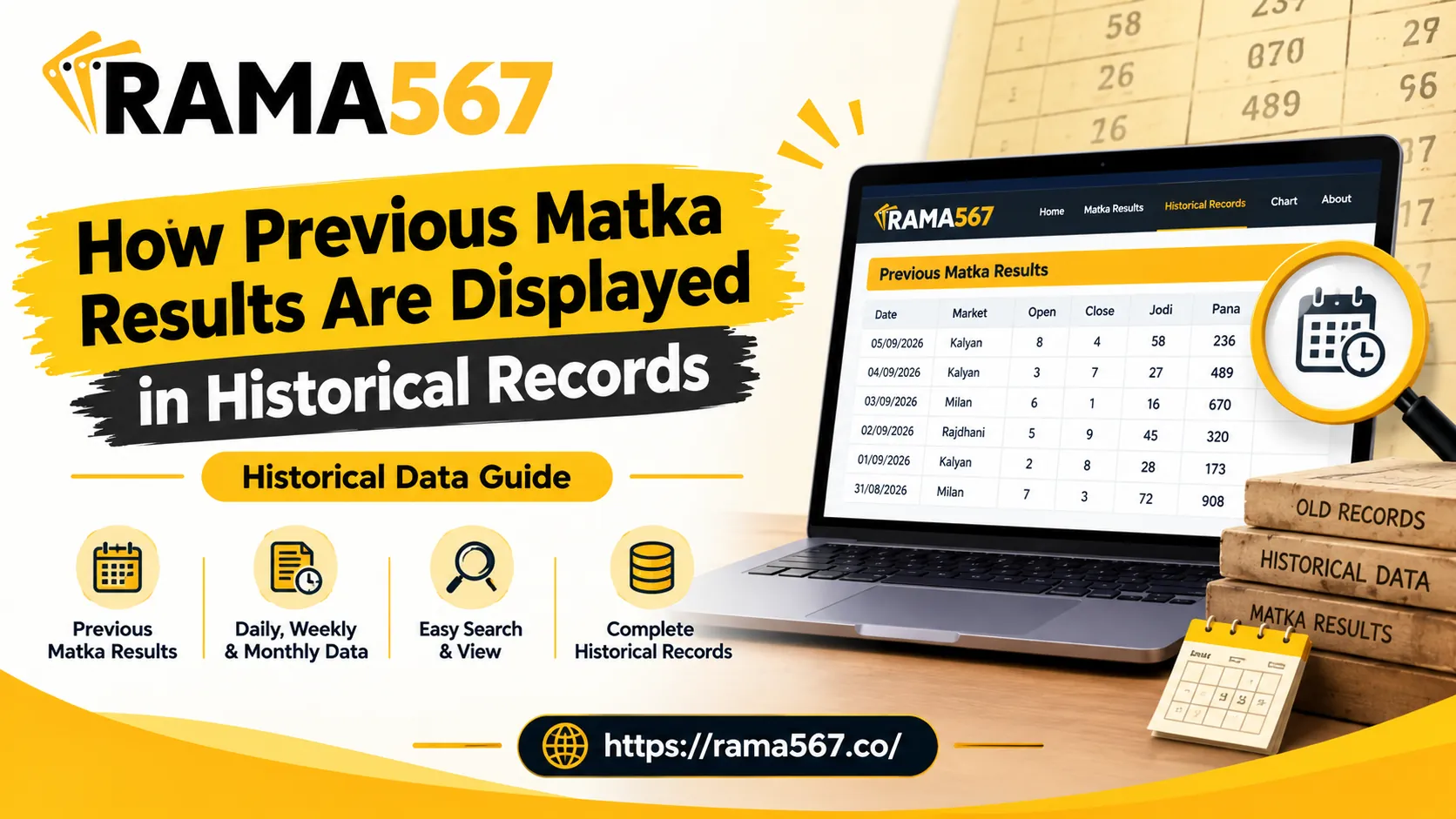
Accessing past Matka results lets readers see how market data from the past was recorded and organized in a period of time. Archives from the past record important information of earlier operating cycles and provide a concise record of the events in past dates and markets.
Knowing how records from the past are organized makes analyzing old entries much easier. This document explains how the previous results are structured, which specific elements are found in archives of the past and also how to comprehend dates and market data correctly, without considering past records as a forecast of the future.
What Are Previous Matka Results?
Past Matka results are simply a record of results declared in previous operations. After a market is completed with its planned run on the day in question, its ending and opening figures are incorporated into an archive.
In contrast to live updates that display market activities, past results function as a reference library. The storage of these results as historical records provides readers with a systematic approach to look back over previous dates, review results across specific time periods, and learn how various market types document their histories. In order to review the old data accurately you must verify both the precise date as well as the exact market name.
What Are Historical Matka Records?
Historic Matka archives function as records of the past's outcomes. Instead of showing information in a random fashion, archives organize the data in order to allow readers to search for particular entries easily.
The platform and publication, archives of the past typically arrange information using:
- Calendar: Chronological listing by the day, week or month.
- Market Name: Categorized entries for specific market entities.
- Time Frame: Divided between the nighttime and daytime is run.
- The Result: Stage is a clear line between Close and Open numbers.
Although layouts vary across sites, the main information stays focused on these fundamental points.
How Previous Matka Results Are Usually Displayed
Historical documents follow a standard layout to allow for easy reading. The typical document groups the most important features into a single row, or entry. This allows users to read the information along with the images.
The following table shows an example of a layout format commonly utilized to display historic entries:
| Date (DD/MM/YYYY) | Market Name | Open Result | Close Result |
|---|---|---|---|
| Sample Date | Sample Market] | Open Figure | Close Figure |
| Sample Date | Sample Market | Open Figure | Close Figure |
NOTE: The above table shows a typical structural layout and archives that actually contain numbers from the market and precise dates.
The entry usually comprises:
- Date: The exact date on which the market was operating.
- Market Name: This is the name of the particular marketplace (e.g., Milan Day).
- Open Results: The original set figure for this session.
- Closed Result: The last reported figure for the session.
Understanding Date-Wise Previous Matka Results
The ability to organize previous Matka results according to date makes it easier for people to keep track of information over time. Archives that are date-wise can be particularly useful when trying to find entries from a particular date in the past.
In navigating records based on dates take the following tips to remember:
- Check that the chosen date coincides with the time you want to observe.
- Differentiate between archives for daily viewing and weekly summary views.
- Make sure the time listed is aligned with the current working hours for that particular market.
Date-wise structure helps avoid the confusion of comparing entries between the same week or days.
Market-Wise Historical Records
Apart from the sorting based on dates Historical archives are also separate by the market name. Since different markets run on separate schedules, their historic records must be read in a separate way.
The most common examples of different market records are:
- Milan Day and Milan Night
- Rajdhani Day and Rajdhani Night
Although two markets may have an identical primary name for example "Milan" or "Rajdhani," the Day and Night versions maintain totally separate archives of historical records. Be sure to confirm the market's full name before you examine archives of entries.
Open and Close Results in Historical Records
Each completed record of historical records typically has two main figures that are the Open outcome and the close outcome.
- Open Result: This is the first result that is declared at the time that the operational cycle of the market commences.
- Close Result: This is the 2nd outcome announced by the operational cycle.
Knowing how the two entries are placed within the chart can help avoid mistaking an opening figure as a closing figure. For more detailed explanations of typical market terminology, check out our tutorial to comprehend Matka outcome terms.
Weekly and Monthly Historical Records
For those who are interested in broader periods of time, historical records tend to be grouped in monthly or weekly views which are often referred to as Matka charts or historical documents.
- Weekly Record: Show results for the week from Monday to Sunday on a single grid.
- Monthly Archives: Aggregate all daily entries for the whole calendar month to be used as a reference for the long term.
This grouping format makes it simpler to find the previous entries without having to go through each day's pages.
How to Read a Previous Matka Result Record
Step 1.Locate the Date
Look at the column at the top or on the side of the document to verify the precise date that the entry was made.
Step 2.Verify the Market Name
Check the title in full the market you're reading to make sure you're not looking at a different market.
Step 3.Check the Day or Night Tag
Check if the entry belongs to an operational window that is open during the day or nighttime operational window.
Step 4.Read the Open Result
Find the first number declared set, which is located under"Open. "Open" column.
Step 5.Read the Close Result
Determine the declared final number listed under"Close" column "Close" column.
Step 6.Cross-Reference Context
Make sure the date, market names, and figures coincide within the same row.
Step 7.Treat as Historical Data
The numbers are viewed strictly to record past instances.
Why Accurate Historical Records Matter
Well-organized, clear archive documents are of great value to those who are looking for reliable data:
- Organized Access: Facilitates quick access to specific entries from the past with no any clutter.
- Clear Identification: Minimizes the chance of errors due to overlapping markets or dates that are similar.
- Historical Reference: Gives you an exact record of the past findings for studying in a context.
- Standardized Structure: Same layout across weekly, daily and tables for the month.
Common Mistakes When Reading Previous Matka Results
If they are looking through old results archives novices often make several common mistakes:
- Incorrectly reading the date: Confusion records from days that aren't related or mistakenly assuming a week's data for a new record.
- Confusion of Similar markets: treating "Day" and "Night" different versions of a market as if they are the same.
- The swapping of Open and Close: Mixing the opening figure, and then the closing figure.
- The mistake of interpreting Old Data as Current: The assumption that an archived data result is the market in real time, and is live.
- Utilizing Unverified Resources: Relying upon poor or badly formatted archives from third parties.
Ensuring that you have the complete header information of any chart before you read the data can help to avoid the common mistakes.
Previous Matka Results on Rama567
Clean, well-categorized information from the past makes analyzing market activities easy. With Rama567 it is possible to access data that is organized according to the name of the market, its date and the time period.
If you're looking to confirm an earlier result or look over chart layouts from the past or review historical chart layouts, these educational guides offer a concise step-by-step guidance for exploring the market archives in a way that is efficient.
Historical Records vs Predictions
It is vital to comprehend the difference between records from the past as well as predictions
- Historical Records: Actual documentation of market results from the past that were already completed.
- Predictions: Uncertainty or speculations about future events.
The purpose of historical archives is to record the past. These events are not a factor in future market trends as such, and charts from the past are not an assurance or a reliable way to forecast future performance.
Responsible and Legal Use
Matka markets include real-money betting and carries a financial risk and is subjected to rigorous rules and laws. The laws regarding online gambling and Matka differ by state and the national level of area of.
Users must comply with the laws of their respective locales and be sure they are in compliance with the legal requirements for age (18plus in many regions). Archives, records from the past and educational material are only provided for informational use and are not to be utilized in the expectation of guaranteeing economic returns.
Conclusion
The previous Matka outcomes serve as documentation of the past, letting users review the past results of markets within a clear and organized context. Through the organization of information according to the date, title of market open figures, Close figures, the historical archives help users navigate through the old data in a way that is simple and effective.
In the event of checking archives ensure that you have the correct date and the correct market name to ensure a correct understanding. Markets can be explored through structured documents and guides to education anytime through Rama567..
Frequently Asked Questions
1.What were the results of some of the previous Matka Results?
The previous Matka outcomes are archived reports of results declared by markets specific to operational periods.
2.What is the way that past Matka results are portrayed in the historical archives?
They're usually displayed as formatted charting or tables that include the date, name of market, the Open result and close outcome.
3.Do I have access to date-wise older Matka Results?
Most archive archives from the past organize their data by chronological order. This allows people to search for entries by certain dates.
4.What's the main difference in Open and Close outcomes?
The Open outcome is an outcome that is announced at the beginning of a session in the market, in contrast, the Close result is made public at the close of the session.
5.Are the previous Matka performance be a guide to future results?
No. Past results are merely historic records of events in the past and are not a guarantee of future results.