Table of Contents
- Introduction: The Crown Jewels of Matka Wagering
- What is Sangam? The Dual-Session Compound Philosophy
- Deconstructing Half Sangam
- Deconstructing Full Sangam: The Ultimate Jackpot
- Master Comparison Table: Half Sangam vs. Full Sangam
- The Mathematical Connection to Jodis and Panas
- Step-by-Step Guide to Placing Sangam Bids on Rama567
- Bankroll Management for Extreme Variance Play
- Frequently Asked Questions (FAQ)
- Conclusion and Next Steps
Introduction: The Crown Jewels of Matka Wagering
Across the landscape of traditional Indian number games, betting formats exist along a wide mathematical spectrum. At one end sits the foundational Single Ank, offering a modest 1:9.5 payout with a 10% base probability. In the center sit Jodis (1:95) and Single Panas (1:160), which form the analytical backbone of daily chart tracking.
At the apex of this hierarchy sit the two most lucrative, high-multiplier formats in the game: Half Sangam and Full Sangam.
Known among veteran enthusiasts as the "Jackpot Formats," Sangam wagers require predicting the outcome of both the Open and Close sessions simultaneously under a single, unified ticket. Because getting both halves of a market correct requires extraordinary analytical precision, the financial returns are staggering:
- A winning ₹100 ticket on a Half Sangam on Rama567 yields ₹1,00,000 (₹1 Lakh) at a 1:1,000 payout multiplier.
- A winning ₹100 ticket on a Full Sangam yields ₹10,00,000 (₹10 Lakhs) at an extraordinary 1:10,000 multiplier.
However, high rewards come with extreme mathematical variance. Bidding blindly on Sangam combinations without understanding the underlying probability pools or proper bankroll management will rapidly deplete capital.
In this comprehensive guide, we dissect the rules governing both Half and Full Sangam, break down their combinatorial odds, analyze how they relate to standard Jodi brackets, and demonstrate how to utilize Rama567 to execute verified, automated Sangam wagers.
What is Sangam? The Dual-Session Compound Philosophy
The Sanskrit and Hindi word Sangam translates literally to "confluence," "union," or "meeting point"—historically referencing the sacred meeting of rivers.
In the context of Matka gaming across premier markets like Kalyan, Milan Day, and Rajdhani Night, Sangam represents the confluence of the Open draw and the Close draw:
   ┌─────────────────────────────────────────────────────────────┐
   │                 The Dual-Session Timeline                   │
   │                                                             │
   │      [Open Session]                 [Close Session]         │
   │   (e.g., 03:00 PM IST)            (e.g., 05:00 PM IST)      │
   │            │                               │                │
   │    ┌───────┴───────┐               ┌───────┴───────┐        │
   │    ▼               ▼               ▼               ▼        │
   │ Open Pana      Open Ank       Close Pana      Close Ank     │
   │  (3-Dig)        (1-Dig)        (3-Dig)         (1-Dig)      │
   │                                                             │
   │   └───────────────────────┬───────────────────────┘         │
   │                           ▼                                 │
   │               COMPOUND SANGAM SELECTION                     │
   └─────────────────────────────────────────────────────────────┘
In standard wagering, you place a bid on an Open Single Ank, settle it, and then decide whether to wager on the Close.
In Sangam betting, your wager spans both events simultaneously. You must lock in your compound prediction before the Open market cut-off arrives. If either half of your compound ticket fails to match the declared result, the entire ticket is settled as a loss. If both halves align, you capture the highest payout multipliers available in the gaming industry.
Deconstructing Half Sangam
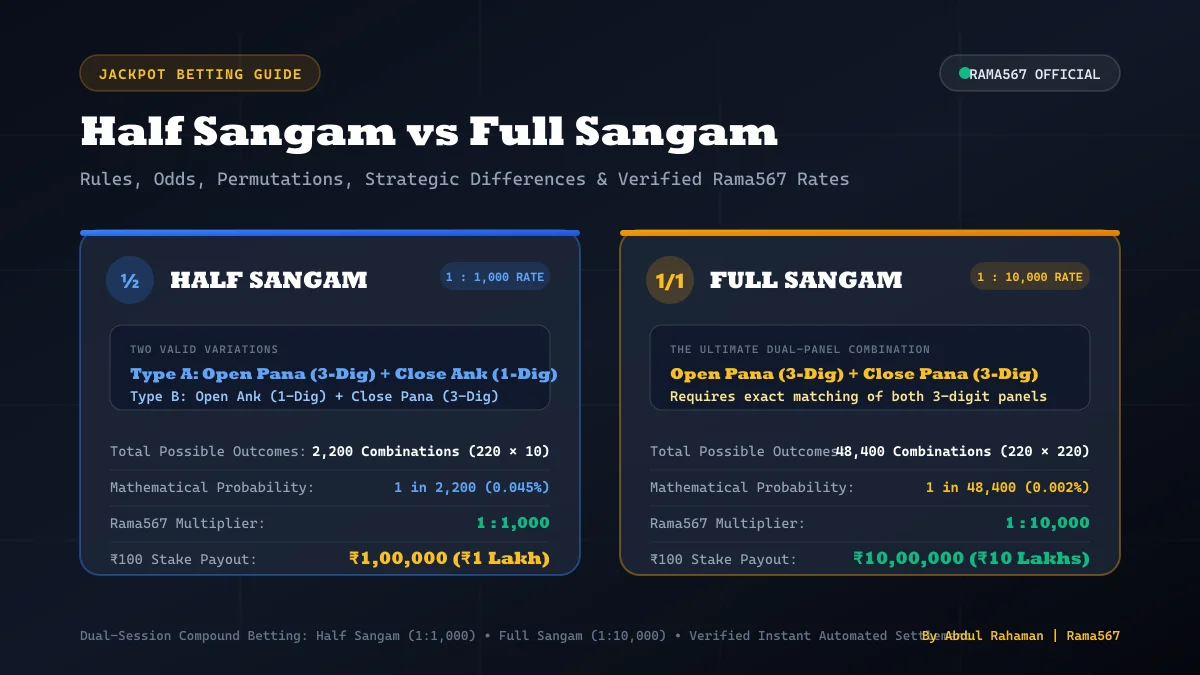
A Half Sangam is a compound wager that couples a three-digit Panna from one session with a single-digit Ank from the complementary session.
Because there are two sessions (Open and Close), Half Sangam exists in two distinct, equally valid configurations:
| Variation | First Element | Second Element | Concrete Example |
|---|---|---|---|
| Type A | Open Panna (3 Digits) | Close Ank (1 Digit) | 137 (Open) + 8 (Cl) |
| Type B | Open Ank (1 Digit) | Close Pana (3 Digits) | 3 (Open) + 247 (Cl) |
Type A: Open Pana + Close Single Ank
In Type A, you predict the exact three-digit panel that will appear during the Open draw, combined with the single digit that will conclude the Close draw.
- Your Selection: Open Panna
137and Close Ank8. - Winning Outcome: The Open draw must declare Panna
137(which sums to $1+3+7=11 \rightarrow$ Open Ank1). Two hours later, the Close draw must produce an outcome whose digits sum to8(such as Close Pana189,279,350, etc.). - If the Open Panna is
137and the Close Ank is8, your ticket wins.
Type B: Open Single Ank + Close Pana
In Type B, the structure is mirrored. You predict the opening single digit, combined with the exact three-digit panel that will emerge on the Close.
- Your Selection: Open Ank
3and Close Panna247. - Winning Outcome: The Open draw can be produced by any of the 22 Panas that sum to
3(e.g.,120,148,238). Then, the Close draw must match247exactly. - If both elements align, your ticket wins.
Combinatorial Odds: The 2,200 Pool
To calculate the exact probability of winning a Half Sangam, we evaluate the size of the total outcome universe:
- There are 220 valid Panas in the Matka system (120 Single Panas, 90 Double Panas, 10 Triple Panas).
- There are 10 Single Anks ($0, 1, 2, \dots, 9$).
- Multiplying the two independent sets:
$\text{Total Half Sangam Outcomes} = 220 \times 10 = \mathbf{2,200}$
$\text{Probability of Specific Outcome} = \frac{1}{2,200} \approx \mathbf{0.0454%}$
Rama567 Payout Rate (1:1,000)
Because the mathematical probability is 1 in 2,200, Rama567 provides an exceptional 1:1,000 payout multiplier:
- ₹10 stake: Returns ₹10,000.
- ₹50 stake: Returns ₹50,000.
- ₹100 stake: Returns ₹1,00,000 (₹1 Lakh).
- ₹500 stake: Returns ₹5,00,000 (₹5 Lakhs).
Deconstructing Full Sangam: The Ultimate Jackpot
If Half Sangam is the major leagues of Matka, Full Sangam is the absolute summit. It is the most challenging, prestigious, and high-yielding wager in the entire number-gaming universe.
          [Open Session]                 [Close Session]
             1 3 7             +             2 4 7
               │                               │
        (Open Panna Only)              (Close Panna Only)
               │                               │
               └───────────────┬───────────────┘
                               ▼
                      FULL SANGAM TICKET
                     137 (Open) × 247 (Close)
The Dual Three-Digit Requirement
In Full Sangam, there are no single-digit approximations. You must correctly predict:
- The exact Open Panna (all 3 digits in ascending order).
- The exact Close Panna (all 3 digits in ascending order).
Example:
- Your Selection: Open Panna
137and Close Panna247. - Draw Result: Open declares
137 - 1, Close declares8 - 247. Complete string:137 - 18 - 247. - Because both three-digit panels match your ticket exactly, you hit the Full Sangam.
Combinatorial Odds: The 48,400 Universe
The mathematical calculation behind Full Sangam explains why its payouts are legendary:
- There are 220 valid Panas for the Open draw.
- There are 220 valid Panas for the independent Close draw.
- Multiplying both possibility spaces:
$\text{Total Full Sangam Outcomes} = 220 \times 220 = \mathbf{48,400}$
$\text{Probability of Specific Outcome} = \frac{1}{48,400} \approx \mathbf{0.002066%}$
Out of forty-eight thousand four hundred possible daily permutations, your ticket represents exactly one.
Rama567 Payout Rate (1:10,000)
Reflecting this extraordinary mathematical difficulty, Rama567 guarantees an industry-leading 1:10,000 payout multiplier:
- ₹10 stake: Returns ₹1,00,000 (₹1 Lakh).
- ₹50 stake: Returns ₹5,00,000 (₹5 Lakhs).
- ₹100 stake: Returns ₹10,00,000 (₹10 Lakhs).
- ₹1,000 stake: Returns ₹1,00,00,000 (₹1 Crore).
Master Comparison Table: Half Sangam vs. Full Sangam
| Parameter | Half Sangam | Full Sangam |
|---|---|---|
| Required Selection | 1 Panna (3 Dig) + 1 Ank (1 Dig) | 2 Panas (Open Pana + Close Pana) |
| Permutation Pool | 2,200 possible combinations | 48,400 possible combinations |
| Mathematical Odds | 1 in 2,200 (0.0454%) | 1 in 48,400 (0.00206%) |
| Rama567 Payout Multiplier | 1 : 1,000 | 1 : 10,000 |
| Winning Return on ₹10 | ₹10,000 | ₹1,00,000 (₹1 Lakh) |
| Winning Return on ₹100 | ₹1,00,000 (₹1 Lakh) | ₹10,00,000 (₹10 Lakhs) |
| Volatility Profile | Very High | Extreme (Jackpot Tier) |
| Submission Deadline | Prior to Open Draw cut-off | Prior to Open Draw cut-off |
| Settlement Time | Immediately upon Close declaration | Immediately upon Close declaration |
The Mathematical Connection to Jodis and Panas
An essential insight that many beginners overlook is that every Sangam wager is intrinsically linked to an underlying Jodi:
- If you wager on Half Sangam
137(Open) and8(Close):- $1 + 3 + 7 = 11 \rightarrow$ Open Ank is
1. - Close Ank is
8. - Therefore, this Half Sangam implicitly bets on the Jodi
18.
- $1 + 3 + 7 = 11 \rightarrow$ Open Ank is
- If you wager on Full Sangam
137(Open) and247(Close):- Open Ank: $1+3+7=11 \rightarrow$
1. - Close Ank: $2+4+7=13 \rightarrow$
3. - This Full Sangam implicitly bets on the Jodi
13.
- Open Ank: $1+3+7=11 \rightarrow$
   ┌────────────────────────────────────────────────────────┐
   │             Payout Comparison on Same Draw             │
   │            (Assuming Result: 137 - 18 - 247)           │
   ├────────────────────────────────────────────────────────┤
   │ Standard Jodi Bet on '18':                             │
   │ ₹100 wagered @ 1:95 ──────────► ₹9,500 Payout          │
   │                                                        │
   │ Half Sangam Bet on '137 + 8':                          │
   │ ₹100 wagered @ 1:1,000 ───────► ₹1,00,000 Payout       │
   │                                                        │
   │ Full Sangam Bet on '137 + 247' (if 247 was close):     │
   │ ₹100 wagered @ 1:10,000 ──────► ₹10,00,000 Payout      │
   └────────────────────────────────────────────────────────┘
Because Sangam betting requires pinpointing the exact three-digit panel rather than just the final sum, you are rewarded with 10x to 100x the payout of a standard Jodi wager.
Step-by-Step Guide to Placing Sangam Bids on Rama567
Executing compound wagers on Rama567 or through the Rama567 Android APK is automated, transparent, and error-proof.
       [Select Target Bazar] (e.g., Kalyan, Milan Day, Rajdhani Night)
                 │
                 ▼
       [Choose 'Half Sangam' or 'Full Sangam' Mode]
                 │
                 ▼
       [Input Selected Numbers]
         - For Half Sangam: Select Open Pana & Close Ank (or vice versa)
         - For Full Sangam: Select Open Pana & Close Pana
                 │
                 ▼
       [Enter Points / Stake] (Minimum ₹10 per ticket)
                 │
                 ▼
       [Cryptographic Slip Generation] (Wallet debited, digital receipt saved)
                 │
                 ▼
       [Open Draw Declaration] ──► Ticket remains 'Active' if Open matches
                 │
                 ▼
       [Close Draw Declaration] ──► Instant settlement in <2 seconds
Pre-Draw Submission Deadlines
Because Sangam wagers incorporate the Open session, all Half Sangam and Full Sangam tickets must be submitted prior to the Open bidding deadline. You cannot place a Half Sangam ticket after the Open result has already been declared.
Automated Two-Stage Settlement Engine
Rama567’s backend handles Sangam tickets through automated lifecycle evaluation:
- Stage 1 (Open Evaluation): When the Open draw is declared at 03:00 PM, the system evaluates the first component of your Sangam. If the Open component misses, the ticket is settled as lost immediately. If the Open component matches, the ticket enters an active "Awaiting Close" state.
- Stage 2 (Close Evaluation): When the Close draw concludes at 05:00 PM, the system checks the final component. If it matches, the complete winning payout (1:1,000 or 1:10,000) is credited to your wallet in under 2 seconds.
Bankroll Management for Extreme Variance Play
Because Full Sangam odds are 1 in 48,400 and Half Sangam odds are 1 in 2,200, these formats must never be played with essential capital. Professional players adhere to strict bankroll guidelines:
1. The "Lottery Pocket" Staking Rule (Max 1% of Bankroll)
Never allocate more than 0.5% to 1% of your total liquid gaming balance to Sangam wagers on any single day:
- If your liquid bankroll is ₹10,000, your maximum Sangam expenditure for the day should be ₹50 to ₹100 (e.g., five ₹10 Half Sangam tickets, or two ₹10 Full Sangam tickets).
- Treat Sangam wagers as low-cost, high-upside lottery plays rather than foundational income generators.
2. Multi-Tier Hedging Architecture
Never wager on a Sangam in total isolation. Anchor your Sangam picks to high-probability foundational bids:
- Foundational Tier (70% of Day's Budget): Bet on the primary Single Ank representing your Open Pana (1:9.5 payout).
- Core Tier (20% of Budget): Bet on the underlying Jodi bracket (1:95 payout).
- Jackpot Tier (10% of Budget): Place small ₹10 or ₹20 tickets on the Half or Full Sangam.
If your Single Ank or Jodi hits, your overall session is profitable, allowing you to chase the Sangam jackpot with zero risk to your primary capital.
For complete bankroll protocols, read our Top 7 Bankroll Management Tips for Responsible Gaming.
Frequently Asked Questions (FAQ)
What is the exact difference between Half Sangam and Full Sangam?
A Half Sangam pairs one 3-digit Panna with one 1-digit Single Ank (either Open Pana + Close Ank, or Open Ank + Close Pana). It has 2,200 possible outcomes and pays 1:1,000. A Full Sangam pairs two 3-digit Panas (Open Pana + Close Pana). It has 48,400 outcomes and pays 1:10,000.
Can I place a Half Sangam bet after the Open result is announced?
No. All Sangam wagers (both Half and Full) must be placed and confirmed before the Open draw bidding window closes.
What is the minimum bet for Sangam on Rama567?
The minimum stake for both Half Sangam and Full Sangam on Rama567 is just ₹10, making jackpot participation accessible without risking substantial capital.
How much does a ₹100 Full Sangam pay on Rama567?
A ₹100 winning ticket on a Full Sangam on Rama567 pays ₹10,00,000 (₹10 Lakhs) at the verified 1:10,000 multiplier, deposited directly into your platform wallet with instant UPI bank withdrawal capabilities.
Where can I study past Panas to plan Sangam entries?
You can analyze lifetime historical panel records across all premier bazars directly in our Live Panel Charts Directory, including Kalyan Panel, Milan Day Panel, and Rajdhani Night Panel.
Conclusion and Next Steps
Half Sangam and Full Sangam represent the pinnacle of excitement and reward in Indian Matka. By understanding the 2,200 combinatorial pool of Half Sangam (1:1,000 rate) and the 48,400 universe of Full Sangam (1:10,000 rate), you can incorporate these high-multiplier formats into your portfolio with realistic expectations and disciplined staking.
Ready to test your analytical precision with guaranteed instant settlements?
- 📊 Analyze the Ledgers: Study the Live Panel Charts Hub.
- 📲 Download the App: Install the Rama567 Android APK for seamless mobile bidding and alerts.
- 🎯 Join Rama567: Register at Rama567 today and experience transparent, real-time gaming.
Disclaimer: Online matka and number gaming involve financial risk and may be habit-forming. This publication is strictly for educational, informational, and analytical purposes. Participants must be 18 years of age or older and comply with all applicable local, state, and national regulations governing real-money gaming in their respective jurisdictions.