Table of Contents
- Introduction: The Engine of Matka Outcomes
- What is a Panna (Patti)? Fundamentals and Historical Roots
- The Universal Ascending Order Rule and the Role of Zero
- Combinatorial Mathematics: The 220 Valid Panna Universe
- The Symmetrical Distribution Matrix: Exactly 22 Panas per Ank
- Related Panna Formats: Motor Patti and Cycle Patti (CP)
- Payout Structures and Mathematical Odds on Rama567
- How to Read Historical Panel Charts on Rama567
- Strategic Principles and Bankroll Management for Panna Wagering
- Frequently Asked Questions (FAQ)
- Conclusion and Next Steps
Introduction: The Engine of Matka Outcomes
In the world of Satta Matka, casual observers often focus exclusively on the single digits (Anks) or two-digit pairs (Jodis). They watch the final board update, see a result like 29, and assume the game is a straightforward two-digit lottery.
However, veteran analysts and professional players know that the true mathematical foundation of every major Indian bazar—from Kalyan to Milan Day and Rajdhani Night—is powered entirely by three-digit combinations known as Pannas (or Pattis).
Every single ank displayed on an official result board is directly derived from a three-digit Panna. When you bet on a single number between 0 and 9, you are participating in a condensed summary of a three-digit draw. Understanding the mechanics of SP (Single Panna), DP (Double Panna), and TP (Triple Panna) transitions a player from relying on arbitrary intuition to operating with a deep mathematical understanding of probabilities, variance, and game structure.
In this comprehensive guide, we dissect the combinatorial mathematics governing all 220 legitimate Panna configurations, break down the universal ascending order rule, illustrate how each single ank is distributed across exactly 22 panels, and explain how the Rama567 platform delivers the industry's most competitive payout multipliers (up to 1:700 on Triple Panas) with instantaneous digital execution.
What is a Panna (Patti)? Fundamentals and Historical Roots
The term Panna (often spelled Patti in regional dialects across Maharashtra, Gujarat, and central India) refers to a three-digit number sequence drawn during each session of a Matka market.
Every complete Matka round consists of two distinct drawing phases:
- The Open Session: A three-digit Open Panna is drawn. Its digits are summed to establish the Open Ank.
- The Close Session: Two to three hours later, an independent three-digit Close Panna is drawn. Its digits are summed to establish the Close Ank.
Joining the Open Ank with the Close Ank produces the definitive two-digit Jodi.
   ┌─────────────────────────────────────────────────────────────┐
   │                Anatomy of a Complete Draw                   │
   │                                                             │
   │      [Open Panna]          [Jodi]         [Close Panna]     │
   │         1 4 7         -     2   8     -       3 6 9         │
   │           │                 ▲   ▲               │           │
   │    1 + 4 + 7 = 12 ──────────┘   └────────── 3 + 6 + 9 = 18  │
   │    (Unit digit: 2)                          (Unit digit: 8) │
   └─────────────────────────────────────────────────────────────┘
Because Panas carry much higher risk profiles than single digits, their payout multipliers are substantially larger. A ₹100 wager on a Single Ank typically returns ₹950 (1:9.5 rate), whereas a ₹100 wager on a Single Panna on Rama567 returns ₹16,000 (1:160 rate), and a Triple Panna returns up to ₹70,000 (1:700 rate).
The Universal Ascending Order Rule and the Role of Zero
A frequent mistake made by beginners is assuming that any random three digits qualify as a playable Panna. In official Matka rules, digits within a Panna must always be sorted in ascending numerical order from left to right:
$d_1 \le d_2 \le d_3$
If the three physical draw tokens drawn are 7, 1, and 4, the ticket is not entered as 714 or 417. It is strictly normalized and sorted as 147.
The Mathematical Role of Zero (0)
In Matka mathematics, the digit 0 does not represent zero in the standard algebraic sense of being less than 1. Instead, 0 represents the value 10 in the sequence.
Consequently, 0 is always positioned as the highest digit, placed at the very end of any combination:
120is valid (1, 2, then 0 representing 10).012is invalid and mathematically impossible under official Matka rules.470is valid.047is invalid.- For Double Panas involving zero:
100is valid (1, 10, 10), whereas001is invalid. - The only valid Triple Panna for zero is
000.
This ascending constraint dramatically reduces the possible combinations from $1,000$ (all three-digit permutations from $000$ to $999$) down to a finite universe of exactly 220 valid Panas.
Combinatorial Mathematics: The 220 Valid Panna Universe
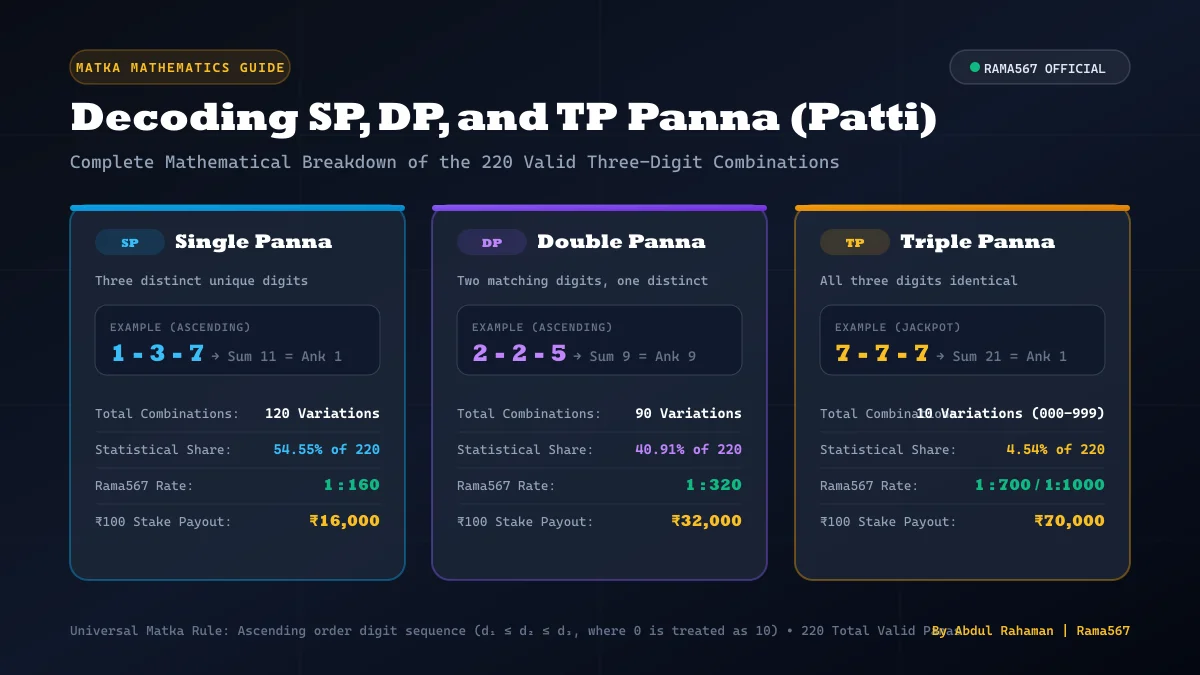
Understanding how the 220 Panas are derived reveals the statistical likelihood of each category. Let us break down the three distinct classes of Pattis:
| Panna Category | Mathematical Criteria | Total Combinations | Share of Universe |
|---|---|---|---|
| Single Panna (SP) | d₁ < d₂ < d₃ | 120 | 54.55% |
| Double Panna (DP) | d₁ = d₂ < d₃ OR d₁ < d₂ = d₃ | 90 | 40.91% |
| Triple Panna (TP) | d₁ = d₂ = d₃ | 10 | 4.54% |
| Total Universe | All Valid Combinations | 220 | 100.00% |
Single Panna (SP): 120 Combinations
A Single Panna consists of three completely distinct, non-repeating digits arranged in strictly ascending order ($d_1 < d_2 < d_3$).
To calculate the total number of Single Panas, we select 3 unique digits out of the 10 available digits ($0, 1, 2, \dots, 9$). Because order is strictly ascending, every subset of 3 unique numbers corresponds to exactly one valid Panna. Using the binomial coefficient formula:
$\binom{10}{3} = \frac{10 \times 9 \times 8}{3 \times 2 \times 1} = 120$
There are exactly 120 Single Panas. Since 120 out of 220 combinations belong to this category, approximately 54.55% of all historical Matka draws result in a Single Panna. This high frequency makes SP the bedrock of analytical chart tracking.
Examples of Single Panas:
123(Sum: $6$, Ank: $6$)147(Sum: $12$, Ank: $2$)358(Sum: $16$, Ank: $6$)280(Sum: $2+8+10 = 20 \rightarrow$ Ank: $0$)
Double Panna (DP): 90 Combinations
A Double Panna occurs when exactly two of the three digits are identical, while the third digit is distinct. The digits must still obey the ascending order rule ($d_1 = d_2 < d_3$ or $d_1 < d_2 = d_3$).
To calculate the total number of Double Panas:
- Choose the digit that will repeat (10 possibilities: $0, 1, 2, \dots, 9$).
- Choose the distinct third digit from the remaining 9 available digits.
- Multiply the selections:
$10 \times 9 = 90$
Every pair of (repeating digit, non-repeating digit) maps to exactly one strictly ordered combination. Thus, there are exactly 90 Double Panas.
Double Panas account for 40.91% of all draws. Because they occur less frequently than Single Panas, they carry twice the payout multiplier on Rama567 (1:320 compared to 1:160 for SP).
Examples of Double Panas:
112(Sum: $4$, Ank: $4$)225(Sum: $9$, Ank: $9$)448(Sum: $16$, Ank: $6$)330(Sum: $3+3+10 = 16 \rightarrow$ Ank: $6$)100(Sum: $1+10+10 = 21 \rightarrow$ Ank: $1$)
Triple Panna (TP): 10 Combinations
A Triple Panna (also known as a Jackpot Patti or Red Patti) occurs when all three drawn digits are identical ($d_1 = d_2 = d_3$).
Because there are only 10 unique digits in the decimal system, there are exactly 10 Triple Panas:
${000, 111, 222, 333, 444, 555, 666, 777, 888, 999}$
Triple Panas represent just 4.54% of the 220-combination universe. Because of their statistical rarity, they offer the highest individual payout multiplier on the platform: 1:700 on standard play (and up to 1:1000 in specialized jackpot biddings).
   ┌────────────────────────────────────────────────────────┐
   │             Triple Panna Modulo-10 Sums                │
   ├────────────────────────────────────────────────────────┤
   │ 111 ──► 1 + 1 + 1 = 3   │  666 ──► 6 + 6 + 6 = 18 ──► 8│
   │ 222 ──► 2 + 2 + 2 = 6   │  777 ──► 7 + 7 + 7 = 21 ──► 1│
   │ 333 ──► 3 + 3 + 3 = 9   │  888 ──► 8 + 8 + 8 = 24 ──► 4│
   │ 444 ──► 4 + 4 + 4 = 12►2│  999 ──► 9 + 9 + 9 = 27 ──► 7│
   │ 555 ──► 5 + 5 + 5 = 15►5│  000 ──► 10+10+10 = 30 ──► 0│
   └────────────────────────────────────────────────────────┘
Summary of the 220 Universe
$120 \text{ (SP)} + 90 \text{ (DP)} + 10 \text{ (TP)} = 220 \text{ Valid Panas}$
Every single result ever recorded in the history of Indian Matka belongs to this exact set of 220 numerical strings.
The Symmetrical Distribution Matrix: Exactly 22 Panas per Ank
One of the most remarkable properties of Matka mathematics is its perfect symmetry. While numbers appear random to casual players, the 220 combinations are distributed completely evenly across the 10 single digits ($0$ through $9$).
Every Single Ank is represented by exactly 22 unique Panas:
- 12 Single Panas (SP)
- 9 Double Panas (DP)
- 1 Triple Panna (TP)
- Total: $12 + 9 + 1 = 22 \text{ Panas per Ank}$
$10 \text{ Anks} \times 22 \text{ Panas} = 220 \text{ Total Panas}$
| Ank | Single Panas (12 SP) | Double Panas (9 DP) | TP (1) |
|---|---|---|---|
| 1 | 128, 137, 146, 236, 245, 290, 380, 470, 489, 560, 579, 678 | 119, 155, 227, 335, 344, 399, 588 | 777 |
| 669, 100 | |||
| 2 | 129, 138, 147, 156, 237, 246, 345, 390, 480, 570, 589, 679 | 110, 228, 255, 336, 444*, 499... | 444 |
| 3 | 120, 139, 148, 157, 238, 247, 256, 346, 490, 580, 670, 689 | 111*, 166, 229, 337, 355, 445... | 111 |
| 4 | 130, 149, 158, 167, 239, 248, 257, 347, 356, 590, 680, 789 | 112, 220, 266, 338, 446, 455... | 888 |
| 5 | 140, 159, 168, 230, 249, 258, 267, 348, 357, 456, 690, 780 | 113, 122, 177, 339, 366, 447... | 555 |
| 6 | 123, 150, 169, 178, 240, 259, 268, 349, 358, 367, 457, 790 | 114, 222*, 277, 330, 448, 466... | 222 |
| 7 | 124, 160, 179, 250, 269, 278, 340, 359, 368, 458, 467, 890 | 115, 133, 188, 223, 377, 449... | 999 |
| 8 | 125, 134, 170, 189, 260, 279, 350, 369, 378, 459, 468, 567 | 116, 224, 233, 288, 440, 477... | 666 |
| 9 | 126, 135, 180, 234, 270, 289, 360, 379, 450, 469, 478, 568 | 117, 144, 199, 225, 333*, 559... | 333 |
| 0 | 127, 136, 145, 190, 235, 280, 370, 389, 460, 479, 569, 578 | 118, 226, 244, 299, 334, 550... | 000 |
Note: In the full 220 matrix, each Triple Panna mathematically reduces to its corresponding single ank ($1+1+1 = 3$, $2+2+2 = 6$, $3+3+3 = 9$, $4+4+4 = 12 \rightarrow 2$, etc.).
This 22-Panna distribution provides an invaluable strategic tool. When an analyst identifies strong historical support for a single digit (for instance, anticipating an Open Ank of 4 in Milan Day), they know there are exactly 22 possible Panas that can produce that outcome.
Related Panna Formats: Motor Patti and Cycle Patti (CP)
In addition to individual SP, DP, and TP selections, modern platforms like Rama567 offer multi-combination variations that allow players to group several numbers under a single ticket.
1. Cycle Patti (CP)
Cycle Patti allows a player to select a specific two-digit base (for example, 45) and automatically place bids on all possible Single Panas containing those two digits across all ten possible third digits:
$\text{CP of } 45 \implies {145, 245, 345, 456, 457, 458, 459, 450}$
Cycle Patti is widely used by players who have identified a two-digit sequence in historical charts but wish to hedge against the final third digit.
2. Motor Patti (SP Motor & DP Motor)
Motor Patti allows you to select a group of 4, 5, or 6 favorite digits. The platform’s wagering software instantly permutes all valid ascending three-digit Panas that can be generated exclusively from that chosen set.
- 4-Digit SP Motor (e.g., digits 1, 3, 5, 8): Generates $\binom{4}{3} = 4$ Single Panas: ${135, 138, 158, 358}$
- 5-Digit SP Motor (e.g., digits 2, 4, 6, 7, 9): Generates $\binom{5}{3} = 10$ Single Panas: ${246, 247, 249, 267, 269, 279, 467, 469, 479, 679}$
- DP Motor: Includes double-digit combinations of the chosen group, generating larger ticket sets for broader coverage.
On the Rama567 Android App, selecting Motor Patti automatically populates your digital slip with all permutations in under half a second, eliminating the tedium of entering 10 or 20 individual tickets manually.
Payout Structures and Mathematical Odds on Rama567
Rama567 provides transparent, industry-standard payout multipliers with no hidden house deductions. Here is how Panna payouts compare against standard Single and Jodi formats:
| Bet Type | Combinatorial Odds | Rama567 Rate | ₹100 Stake Payout |
|---|---|---|---|
| Single Ank | 1 in 10 (10.0%) | 1 : 9.5 | ₹950 |
| Jodi | 1 in 100 (1.00%) | 1 : 95 | ₹9,500 |
| Single Panna (SP) | 1 in 220 (0.45%) | 1 : 160 | ₹16,000 |
| Double Panna (DP) | 1 in 220 (0.45%) | 1 : 320 | ₹32,000 |
| Triple Panna (TP) | 1 in 220 (0.45%) | 1 : 700 / 1:1000 | ₹70,000 - ₹100,000 |
| Half Sangam | 1 Pana + 1 Ank | 1 : 1,000 | ₹100,000 |
| Full Sangam | Open Pana + Close Pana | 1 : 10,000 | ₹1,000,000 |
For complete game rules and format tutorials, review our official How to Play Guide.
Why the Rates Differ Between SP, DP, and TP
Although any individual three-digit Panna has the exact same probability of being drawn from the 220-item drum (1 in 220, or approximately $0.45%$), the overall category frequency differs drastically:
- When you place an open-ended bid on "Any Single Panna," you have a 54.55% chance that the drawn result will be of the SP type.
- An open-ended bid on "Any Double Panna" sees only a 40.91% category occurrence.
- An open-ended bid on "Any Triple Panna" sees a rare 4.54% category occurrence.
This is why Rama567 offers ₹320 per ₹1 on Double Panas and up to ₹700 per ₹1 on Triple Panas—rewarding the higher category difficulty with exponential returns.
How to Read Historical Panel Charts on Rama567
To track which Panas are recurring, overdue, or clustering in cycles, players consult dedicated Panel Charts (also known as Patti Charts).
While standard Jodi Charts show only the two-digit core (e.g., 29), a Panel Chart records the complete three-part notation:
$\mathbf{345 - 29 - 180}$
Sample Kalyan Panel Chart Slice:
| Date | Open Panna | Jodi | Close Panna |
|---|---|---|---|
| 2026-10-06 | 138 | 24 | 158 |
| 2026-10-07 | 246 (SP) | 29 | 478 (SP) |
| 2026-10-08 | 117 (DP) | 90 | 389 (SP) |
| 2026-10-09 | 450 (SP) | 95 | 226 (DP) |
| 2026-10-10 | 777 (TP) | 18 | 134 (SP) |
Key Indicators to Monitor on Panel Charts:
- Panel-Type Alternation: If a market records 5 consecutive Single Panas on the Open, the probability of a Double Panna appearing begins to increase from a mean-reversion perspective.
- Repeating Digits across Sessions: Frequently, a digit that appeared in the Open Panna (e.g., the
7in147) recurs in the Close Panna (e.g.,379), reflecting rotational panel alignment. - Cut Panel Relationships: Just as single anks have cut pairs ($1 \leftrightarrow 6, 2 \leftrightarrow 7, 3 \leftrightarrow 8, 4 \leftrightarrow 9, 5 \leftrightarrow 0$), experienced analysts track Cut Panas, where each digit of a panel is converted to its complementary opposite (e.g., the cut of
123is678).
You can inspect full lifetime records for every bazar on Rama567:
- Kalyan Panel Chart
- Milan Day Panel Chart
- Milan Night Panel Chart
- Rajdhani Day Panel Chart
- Rajdhani Night Panel Chart
- Time Bazar Panel Chart
Strategic Principles and Bankroll Management for Panna Wagering
Because individual Panna odds are 1 in 220, playing Panas without strict bankroll controls will rapidly deplete a player's capital during cold streaks. Professional players follow disciplined protocols:
1. The Pyramid Staking Strategy
Never bet on a Panna in isolation. Instead, anchor your Panna selection to a foundational Single Ank wager:
- Allocate 70% of your session stake to the primary Single Ank (e.g., ₹700 on Ank 4 at 1:9.5).
- Allocate 20% of your stake across 2 to 4 high-probability Single Panas representing Ank 4 (e.g., ₹50 each on
149,239,347,158at 1:160). - Allocate 10% of your stake to 1 Double Panna or Motor permutation (e.g., ₹100 on DP
455at 1:320).
Under this pyramid model, if your Single Ank lands, your base capital is protected and yields a profit—even if your exact Panna misses. If your Panna hits, your total return compounds exponentially.
2. The 1% Maximum Exposure Rule
Because Panna volatility is substantially higher than Jodi or Ank play, never commit more than 1% of your total liquid wallet balance to a single Panna ticket. If your account holds ₹10,000, your maximum individual Panna stake should remain ₹100.
3. Hedging via Motor Patti
Rather than guessing a single 3-digit combination, use the 5-digit SP Motor feature on Rama567. By wagering ₹10 across all 10 generated combinations (total outlay ₹100), you expand your coverage tenfold while preserving the potential for a ₹1,600 return if any combination hits.
Frequently Asked Questions (FAQ)
What is the exact difference between SP, DP, and TP in Matka?
- SP (Single Panna): Consists of three completely unique digits in ascending order (e.g.,
137). There are 120 total SPs paying 1:160 on Rama567. - DP (Double Panna): Consists of two identical digits and one distinct digit (e.g.,
225). There are 90 total DPs paying 1:320 on Rama567. - TP (Triple Panna): Consists of three identical digits (e.g.,
777). There are 10 total TPs paying 1:700 on Rama567.
Why are there only 220 Panas instead of 1,000?
Matka rules strictly require all digits within a Panna to be ordered in ascending numerical sequence ($d_1 \le d_2 \le d_3$, with $0$ treated as the highest value, $10$). This ascending requirement eliminates duplicate permutations (e.g., 321, 213, and 312 all normalize to the single entry 123), reducing the 1,000 permutations to exactly 220 unique combinations.
How does a Panna determine the Single Ank?
All three digits of the Panna are added together. The units digit (last digit) of the resulting sum becomes the official Single Ank. For example, for Panna 358: $3 + 5 + 8 = 16$. The units digit is 6, so the Single Ank is 6.
What is Motor Patti on the Rama567 App?
Motor Patti is a feature that allows you to choose 4, 5, or 6 favorite digits. The platform automatically generates and wagers on all valid ascending three-digit Panas that can be formed from those numbers, saving you from entering dozens of slips manually.
Where can I practice or check live Panna results?
You can track real-time sub-second Panna results across all major markets on the Rama567 Live Result Feed or inspect full historical records on the Market Charts Hub.
Conclusion and Next Steps
Mastering the mathematical universe of Single, Double, and Triple Panas transforms how you understand Indian Satta Matka. Instead of viewing results as isolated digits, you now understand the underlying 220-panel engine, the symmetrical 22-Panna distribution for each Single Ank, and how to balance risk and reward between 1:160 SPs, 1:320 DPs, and 1:700 TPs.
To put this knowledge into practice with guaranteed instant payouts and zero-latency WebSocket feeds:
- 📈 Inspect Historical Trends: Study the Kalyan Panel Chart and Milan Day Panel Chart.
- 📱 Download the Official App: Install the Rama567 Android APK for lightning-fast Motor Patti bidding and push alerts.
- 🎯 Join Rama567: Create your account at rama-567.com and experience transparent, real-time gaming.
Disclaimer: Online matka and number gaming involve financial risk and may be habit-forming. This publication is strictly for educational, informational, and analytical purposes. Participants must be 18 years of age or older and comply with all applicable local, state, and national regulations governing real-money gaming in their respective jurisdictions.